16 Reasons Janitorial Companies in Houston Stand Out

If you're comparing janitorial companies in Houston, you already know the sales pitch gets old fast. What usually gets missed is the stuff that actually affects your building: missed touchpoints, weak follow-through, crews that don't understand your site, and problems that show up by 9 a.m.
That's what this list is really for. Not fluff. Just the things facility managers should look at before a low bid turns into extra complaints, extra oversight, and extra risk.
Use it to narrow the field fast.
1. They Clean for Health, Not Just Appearance
A lot of buyers still start by looking at shine. We get it. Clean glass, polished floors, empty trash cans. But in active commercial buildings, that’s only part of the job.
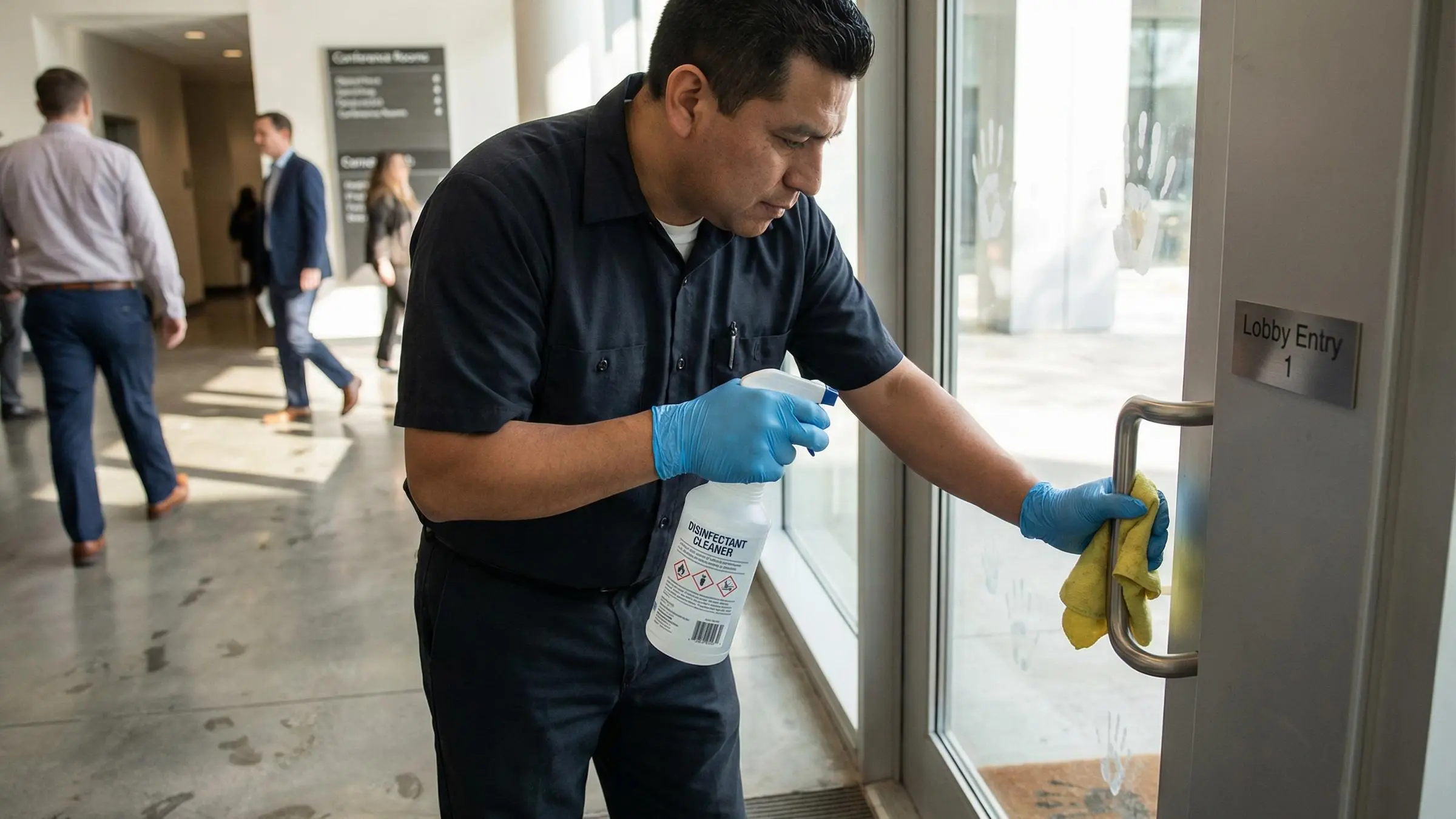
The better janitorial companies in Houston clean for health first. That means high-touch points, restrooms, breakrooms, entrances, shared desks, and other traffic-heavy areas get real attention, not just a quick pass because they “look fine.”
In practice, the difference shows up fast:
Fewer complaints about restrooms by mid-morning
Less buildup on door hardware, counters, and shared surfaces
More confidence from staff, visitors, students, patients, or tenants
Fewer disruptions caused by preventable sanitation issues
A floor can shine and still be a problem. That’s the part some vendors hope you don’t look at too closely.
Strong commercial janitorial services Houston facilities rely on are built around occupant well-being. Appearance still matters. It always will. But if the cleaning plan doesn’t protect the people using the space, it’s incomplete.
2. They Understand Houston’s Wide Range of Commercial Facilities
Houston is not one building type. A downtown office tower, a church campus, a school, an airport area, and an industrial site do not run the same way, and they should not be cleaned the same way either.
Good janitorial companies in Houston Texas adjust to the building in front of them. They don’t drag the same checklist from site to site and hope nobody notices.
A medical clinic has infection-control concerns. A warehouse has dust, traffic lanes, and safety exposure. An office may need daytime touch-up support without disrupting meetings. Airports and public-facing facilities add security and nonstop use. Churches often need respectful scheduling around services and events.
That’s why customized scopes matter. So do site instructions, access rules, and schedules that fit how the building actually operates.
If cleaning gets in the way of operations, the plan wasn’t built correctly.
Facility-specific knowledge is what separates a usable service plan from a generic one.
3. They Rely on Structured Systems, Not Individual Guesswork
This is a big one. The strongest providers don’t depend on one great supervisor or one dependable cleaner to hold everything together.
They use systems.
That means defined roles, job cards, checklists, documented procedures, and a repeatable way to cover the building. In larger facilities, team cleaning models usually outperform loose assignment methods because they improve speed and consistency without turning the job into chaos.
We’ve seen this for years. When staffing changes, a system carries the standard forward. When a site gets busier, a system scales. When a company runs on memory and good intentions, performance starts slipping the second one key person is out.
Our industry talks a lot about service. It should talk more about execution. An Innovative Cleaning System, or any disciplined operating model like it, matters because it standardizes results without making service feel robotic.
4. They Use In-House Employees Instead of Subcontractors
For many facility managers, this is where the real risk conversation starts.
Direct-hire W-2 staffing gives you clearer accountability. The company owns the training, supervision, payroll compliance, workers’ compensation, and day-to-day performance. That matters a lot in buildings with security requirements, sensitive areas, or long operating hours.
Subcontracting can look efficient on paper. On-site, it often creates blur.
You may end up with:
Uneven training from crew to crew
Weak oversight
Confusion around who is actually responsible
Security concerns after hours
Higher turnover and less familiarity with your building
Strong janitorial companies in Houston stand out because they can train, monitor, and retain their own teams. In sensitive facilities, that’s not a detail. It’s the whole game.
5. They Build Quality Control Into Daily Operations
The best providers don’t wait for your team to discover missed work three days later.
Quality control has to live inside daily operations. That usually means inspections, cleaning logs, supervisor follow-up, audit routines, and documented correction when something is off. Multi-area facilities especially need this. A missed restroom, neglected breakroom, or supply issue can spread frustration fast.
A decent service program should leave a trail you can review. Not paperwork for its own sake. Proof that work was checked, issues were noted, and someone followed through.
Here’s the practical test: when something slips, do you hear excuses, or do you see a process?
Reactive complaint handling is cheap. Documented accountability is harder. It’s also better.
6. They Prioritize Safety Compliance as a Core Discipline
Safety isn’t a poster on a breakroom wall. It’s operational discipline.
The providers worth keeping usually have OSHA-trained leadership, regular safety meetings, PPE standards, chemical handling training, and routine site inspections. Not because it sounds impressive. Because people get hurt when those things are loose.
This matters even more in schools, medical buildings, industrial facilities, and manufacturing spaces where hazards change by area. One room may be straightforward. The next may involve traffic, equipment, sharps awareness, or exposure controls.
Professional janitorial services Houston TX organizations trust should be able to explain their safety expectations clearly. If a provider gets vague here, pay attention. Vague safety language usually means inconsistent field behavior.
7. They Prevent Cross-Contamination With Smarter Tools and Protocols
Professional cleaning should not spread problems from one area to another. Yet that happens more often than buyers realize.
The fix is not complicated, but it does require discipline:
Separate cloths and mop heads for restrooms and food spaces
Surface-based workflows for disinfection
Clear chemical use by task and location
Restroom tools should never drift into breakrooms. Shared touchpoints need a defined approach, not random wipe-downs. Medical-adjacent spaces need tighter separation than a standard office. None of this is overkill.
Strong janitorial companies in Houston Texas treat cross-contamination prevention like standard operating practice. That’s a sign of professionalism. The crews that skip these basics are usually skipping other things too.
8. They Offer Day Porter Support for High-Traffic Buildings
Night cleaning handles a lot. It does not handle everything.
In active buildings, day porter service fills the gap between scheduled nightly work and what actually happens during the day. Spills, lobby traffic, restroom supply issues, conference room resets, trash overflow, touch-up cleaning, and real-time disinfection don’t wait until after hours.
That support is especially useful in:
Office buildings with steady daytime traffic
Schools and campuses
Airports and transit-facing spaces
Public-facing facilities where appearance changes by the hour
A good building janitorial service program layers this support where it makes sense. Hybrid occupancy made this even more obvious. Some buildings are quiet one day and heavy the next. Day porters give you flexibility without forcing the night crew to solve daytime problems they’ll never see.
9. They Combine Routine Cleaning With Deep Cleaning and Floor Care
Routine janitorial work keeps the building functioning. It does not replace periodic heavy work.
That distinction matters. Daily trash removal, restroom sanitation, dusting, vacuuming, and surface cleaning are one part of the picture. Deep cleaning, carpet extraction, VCT stripping and waxing, tile and grout restoration, and high dusting are another.
If those periodic services get ignored, you usually notice it in stages. Floors lose finish. Carpets hold odor. Dust collects in places nobody checks until someone important walks through.
The strongest commercial janitorial services Houston buyers choose usually offer a layered service model. That helps with asset protection and gives you one accountable partner for routine work and specialty needs. Bundling alone isn’t the win. Consistent execution is.
10. They Bring Advanced Disinfection Capabilities When Needed
Not every space needs heightened disinfection every day. Some absolutely do at certain times.
Facility leaders should know the difference between routine cleaning, sanitizing, and disinfection. They are not interchangeable. Cleaning removes soil. Sanitizing reduces bacteria on certain surfaces. Disinfection is a higher-level process using the right EPA-approved products and contact times.
Electrostatic spraying can be useful in the right setting because it helps distribute disinfectant across hard-to-reach and irregular surfaces. But the sprayer is only the delivery method. If the product, dwell time, or operator protocol is wrong, the technology doesn’t save the job.
This matters most in schools, medical spaces, shared offices, transit areas, and post-exposure response. Be careful with flashy claims. Good disinfection work is usually more disciplined than dramatic.
11. They Support Green Cleaning Without Sacrificing Performance
A lot of people still assume green cleaning means weaker results. That’s old thinking.
When done correctly, green cleaning improves indoor conditions without giving up performance. The practical tools matter more than the label:
Non-toxic or biodegradable chemicals where appropriate
Microfiber systems that capture soil efficiently
HEPA-filter vacuums for better particulate control
Energy-efficient equipment with lower impact on indoor environments
For facilities with sustainability goals or LEED-aligned expectations, that approach fits naturally. It also helps with indoor air quality, occupant comfort, and reducing complaints tied to strong chemical exposure.
Bad process makes any product look weak. Good process makes smart product choices work.
12. They Know How to Work Inside Secure Buildings
Security is often the deciding factor, especially in offices, schools, churches, airports, and medical buildings.
Reliable teams are trained on lock-in and lock-out procedures, access control, restricted zones, unauthorized entry prevention, and after-hours rules. They know how to handle keys, coded doors, alarm procedures, and site-specific instructions without improvising.
Background checks and supervisor oversight matter here too. Familiar crews matter. So does knowing who was in the building and when.
A real building janitorial service partner protects cleanliness and controlled access at the same time. You shouldn’t have to trade one for the other.
13. They Respond to Emergencies Without Chaos
Emergency response sounds good in a sales pitch. It’s much harder in real life.
Floods, spills, biohazard incidents, urgent sanitation events, and other disruptions require defined escalation procedures and a team that can move without confusion. That’s different from regular nightly janitorial work. It needs communication, availability, and people who know their roles under pressure.
Ask direct questions:
Who gets the call first?
What’s the response window?
How is the site supervised?
What gets documented after the fact?
Operational resilience is not about saying yes to everything. It’s about responding cleanly when normal conditions break.
14. They Adapt to Sensitive Environments With Specialized Training
Some environments punish generic service faster than others.
Medical facilities need infection-control awareness, CDC-aligned practices, and staff who understand privacy expectations around patient areas. Industrial sites demand PPE discipline, hazard awareness, and safe work around active operations. Airports and public-facing spaces need process control plus professional conduct in plain view. Churches often require scheduling flexibility, respectful behavior, and teams that understand trust matters as much as technique.
An experienced crew knows the room changes the work. That should be obvious, but in this business it often isn’t.
15. They Use Technology and Documentation to Improve Transparency
Most facility leaders don’t want another verbal promise. They want proof.
Time tracking, work orders, inspection records, cleaning logs, and digital reporting all help you verify performance and resolve issues quickly. In larger or more complex environments, especially airports and compliance-heavy operations, tighter documentation is often non-negotiable.
Transparency also helps with budgeting. When work is documented, it’s easier to justify scope changes, address recurring trouble spots, and measure whether the service plan actually fits the building.
When comparing janitorial companies in Houston, this is a practical filter. If reporting is thin, oversight usually is too.
16. They Invest in Employees, and Clients Feel the Difference
This one gets overlooked because it sounds soft. It isn’t.
Stable teams usually beat cheap churn. When a company invests in people through training, support, promotion from within, language development like ESL classes, and even emergency assistance when life hits hard, retention improves. And clients feel that difference on-site.
You get familiar crews. Better site knowledge. Fewer repeated mistakes. Less time reteaching basic expectations.
In our world, ethical labor practices are not separate from service quality. They drive it. A team that stays, learns the building, and has real support behind them will usually outperform a low-cost operation that’s rebuilding its crew every few weeks.
How to Evaluate Janitorial Companies in Houston Without Getting Distracted by Price Alone
Price matters. It’s just not enough.
When you compare providers, look past the walkthrough and ask how the operation actually runs. Focus on staffing model, supervision, training, quality control, safety leadership, documentation, security protocols, and experience with your building type.
A few questions worth asking:
Is the staff in-house or subcontracted?
Who supervises the site?
How is performance inspected and documented?
How are issues escalated?
How is the scope customized for our traffic and risk profile?
Can the provider handle deep cleaning, floor care, and disinfection when needed?
The lowest bid often carries hidden costs. Missed work, complaints, turnover, security exposure, and constant follow-up all cost time. Sometimes more than the spread between proposals.
What the Best Commercial Janitorial Services in Houston Usually Include
A solid program starts with routine work and layers services based on the building.
Core commercial janitorial services Houston facilities commonly need include trash removal, restroom sanitation, dusting, vacuuming, surface cleaning, and common-area upkeep. From there, the scope may expand to day porter coverage, deep cleaning, carpet extraction, floor refinishing, targeted disinfection, and emergency response.
Scheduling matters too. Some sites need nights. Some need weekends. Some need active daytime support without disrupting operations. A good building janitorial service plan fits the building instead of forcing the building to fit the vendor.
More services don’t automatically mean better service. Breadth only helps if execution stays disciplined.
Conclusion
The janitorial companies in Houston that truly stand out are the ones that protect health, manage risk, respect security, and deliver consistent results through systems instead of promises.
If you’re evaluating providers, don’t get stuck at price or appearances. Look at staffing, training, safety, quality control, transparency, and whether the company actually understands your facility. That’s where the real difference lives.
Start with your current scope. Review your highest-risk gaps. Then talk with a provider that can build a commercial cleaning plan around how your building really works.