
Janitorial Service Transparency in Houston Explained
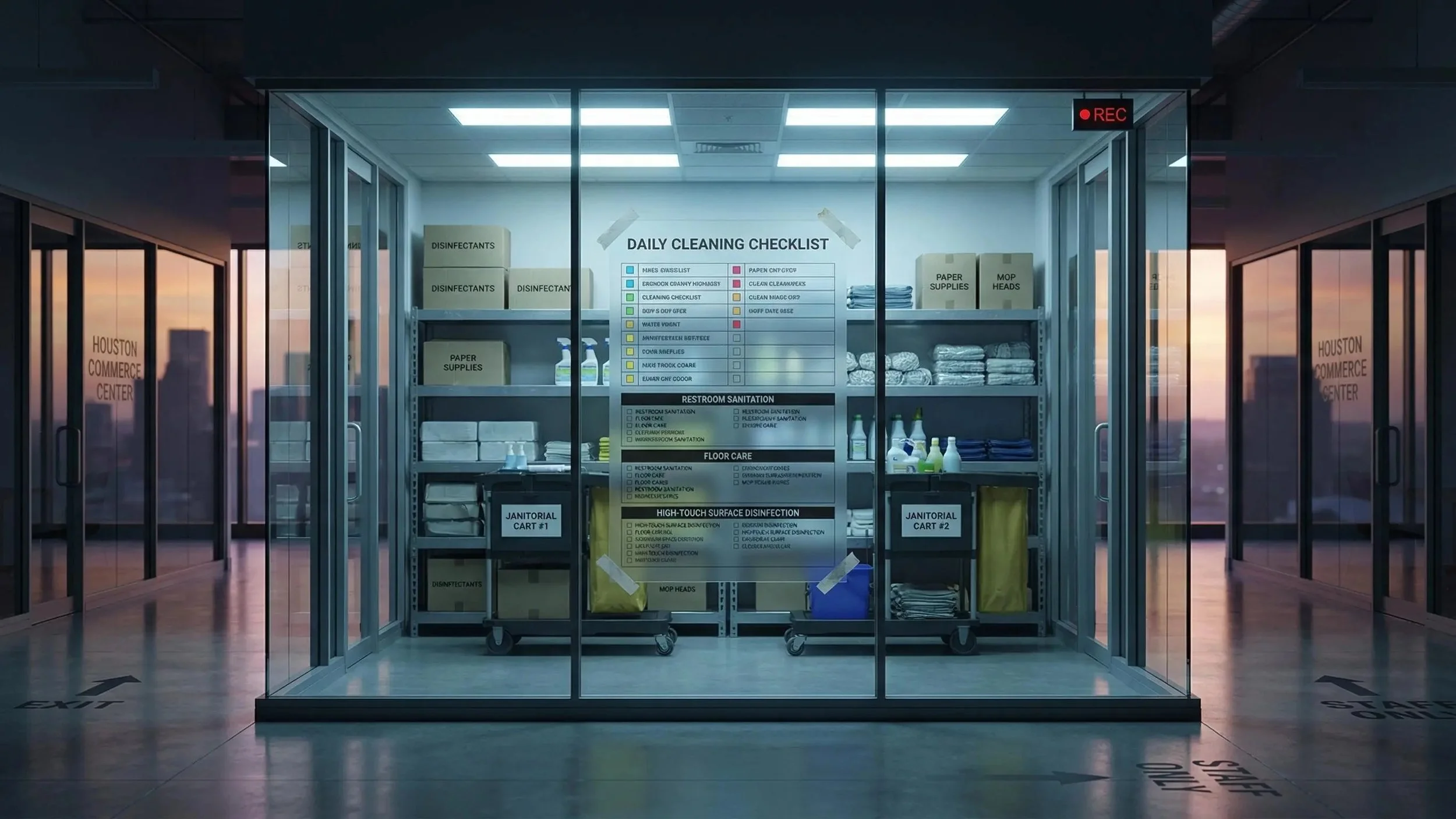
Janitorial service transparency in Houston gets talked about like it's just pricing, but that's usually where people get burned. You get a clean-looking proposal, a flat number, and not much else. Then the questions start: what gets done nightly, what gets skipped, and who is actually checking the work?
What matters is whether you can see the system behind the service (not just the sales pitch). For Houston facility teams, that means clear scope, real documentation, and fewer surprises after hours.
Task frequency should be spelled out by area, not buried in one line
Cleaning logs and inspections matter when your building is active before sunrise
Staffing, safety, and access rules need to be clear before day one
Read this and you'll spot the gaps faster.
What Janitorial Service Transparency Means in a Commercial Facility
In commercial cleaning, transparency isn't just a cleaner quote. It's visibility into how the work gets done, who does it, how it's checked, and what happens when something slips.
A lot of proposals stop at price and square footage. That tells you almost nothing.
Real janitorial service transparency means you can see the operating system behind the service:
scope by area and task
staffing and supervision
cleaning methods and products
safety practices
logs, inspections, and corrective actions
That matters because most of the work happens when you aren't there. After hours, early mornings, between shifts. In a school, medical building, office, airport, church, or industrial site, invisible work without documentation creates risk fast. You don't just need a vendor who says the building will look clean. You need a partner who can show how standards are set, tracked, and corrected.
If the work can't be explained, it usually can't be managed.
For facility managers, transparency is a risk-control tool. It protects health, occupant experience, security, and budget. It also gives you something concrete to manage against when expectations change or problems show up.
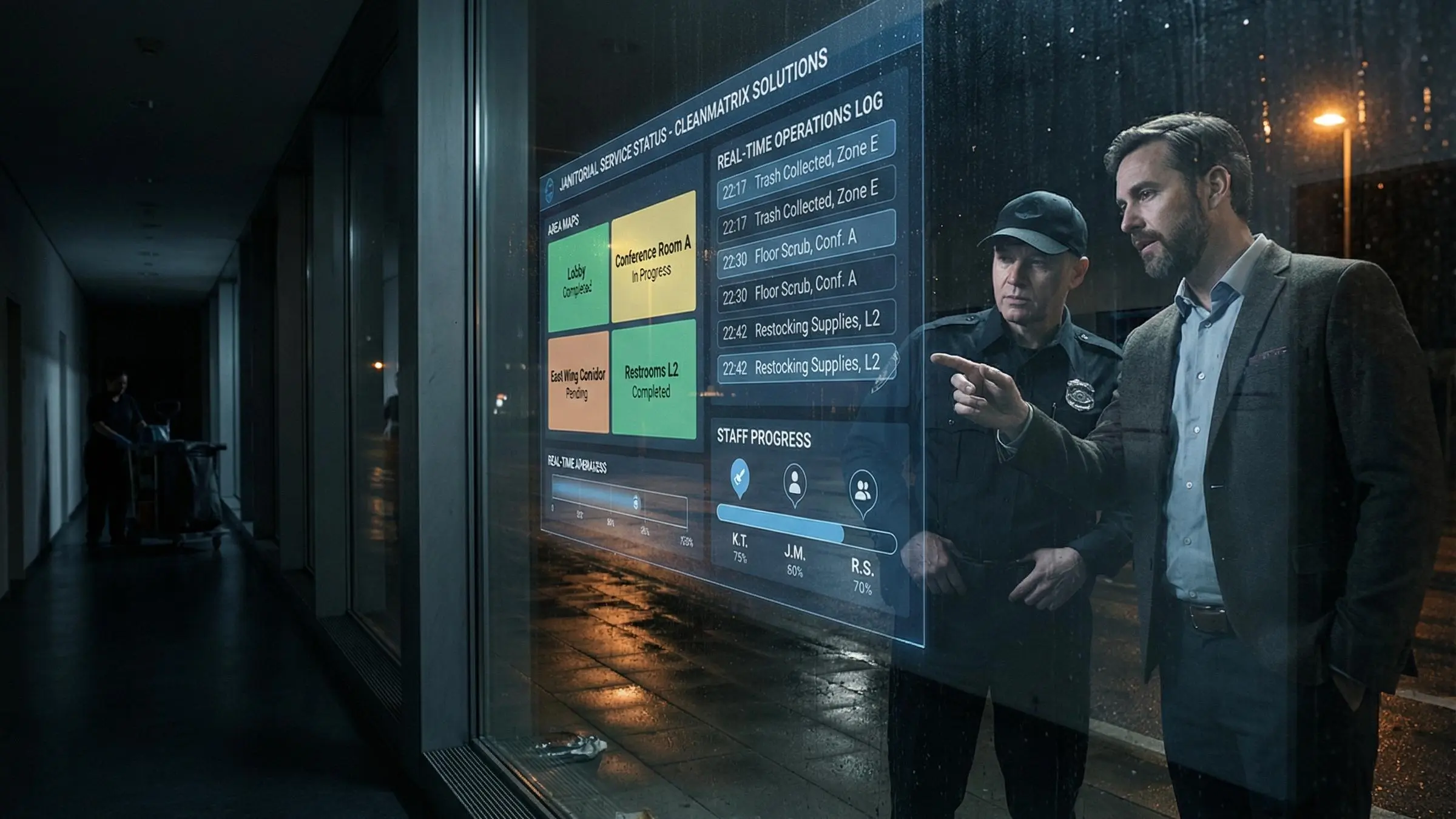
Why Houston Facility Managers Are Right to Be Skeptical
Most decision-makers in Houston have seen the same pattern. A proposal comes in with phrases like "general cleaning" or "standard service," and you're supposed to assume everyone means the same thing.
They don't.
Confusion starts early. Does "restroom service" include full sanitization or just restocking and wipe-downs? Are high-touch points disinfected nightly or only during flu season? Is carpet extraction included anywhere, or is that a separate charge waiting for month three?
The problem in commercial cleaning is simple. The invoice shows up, but you may never have seen the actual work happen.
That gap creates tension in every kind of facility:
a school administrator gets complaints about restroom conditions
an office tenant notices smudged glass and missed trash
a medical waiting area looks fine but high-touch protocols weren't followed
an industrial site has cleaning around production zones that wasn't handled to site rules
By then, you're not reviewing service. You're reacting to failure.
Skepticism is reasonable. We'd be skeptical too. The answer isn't more polished promises. It's more structure you can verify before and after the work is done.
What Transparent Janitorial Service Looks Like in Practice
Transparent service is concrete. You can point to it. You can verify it. And the crew can follow it without guessing.
That starts with documented task lists by space type. Restrooms shouldn't be described the same way as conference rooms. A classroom isn't cleaned like a breakroom. Production-adjacent areas have their own restrictions. Good service plans reflect that reality instead of flattening everything into one vague scope.
You'll usually see clarity like this:
daily tasks for restrooms, touchpoints, trash, and visible soil
weekly tasks for detail wiping, edges, spot treatment, and certain floor care
monthly, quarterly, or annual tasks for carpet extraction, high dusting, tile and grout work, or VCT floor refinishing
job cards and checklists that tell crews what should happen in each area
cleaning logs and inspections showing what did happen
Routine janitorial services and day porter services get much easier to evaluate when responsibilities are written down this way. Otherwise, people end up arguing over assumptions.
The non-obvious part is quality assurance. A transparent provider doesn't wait for your complaint to discover a problem. There should be routine inspections, supervisor audits, and a clear path for issue escalation before your team sends the email nobody wants to write.
The Difference Between Transparent Scope and Vague Scope
A lump-sum cleaning description sounds efficient until you try to hold someone to it.
"Full janitorial service" can mean almost anything. That's the problem.
A transparent scope breaks service into usable detail. Not to create paperwork for its own sake, but so both sides know what is included, what is periodic, and what requires separate approval. Without that, price comparisons are fake. You're not comparing the same service.
Vague scope often leaves out critical questions:
are surfaces being disinfected or simply wiped
which floors get routine maintenance and which get periodic restoration
are consumables, equipment, and specialty chemicals included
is daytime touch-up support part of the contract
what happens for after-hours requests or emergency response
Frequency is where a lot of trouble hides. Periodic services like high dusting, carpet extraction, grout restoration, and floor refinishing can be essential in one facility and irrelevant in another. If those details aren't spelled out, the service won't age well. It may look fine the first few weeks. By the second month, wear starts showing.
A useful scope also reflects operating conditions. Access windows, occupancy patterns, security procedures, restricted areas, and event schedules all affect execution. If a proposal ignores those conditions, it isn't transparent about the real work.
Transparency in Pricing and Invoicing Without Hidden Surprises
Pricing should connect cleanly to scope. If it doesn't, you'll spend too much time decoding invoices later.
A fair commercial janitorial proposal should show line-of-sight between what was quoted and what gets billed. You should be able to tell what belongs to routine service, what counts as periodic work, and what triggers specialty charges.
That usually means the quote should clarify:
labor assumptions
service frequency
supply inclusion
special site conditions
extra or non-routine work categories
Weekend access, emergency response, specialty disinfection, and floor restoration are common places where billing disputes start. Not because the work wasn't needed, but because nobody defined it properly upfront.
Clear invoicing protects both sides. It reduces back-and-forth, reinforces what was performed, and keeps contract management from turning into detective work. Busy facility teams don't need more paperwork. They need fewer surprises.
Why Documentation Matters More Than Verbal Assurances
Verbal promises fade. People change roles. Supervisors rotate. Crews turn over. Buildings change use over time. Documentation is what keeps the standard intact when memory doesn't.
In real operations, documentation connects the proposal to the crew, the supervisor to the client, and the expected result to the actual result.
The most useful forms of documentation include:
site-specific job cards
cleaning logs
inspection reports
supply tracking where relevant
This matters even more in facilities with detailed access rules or room-by-room variation. A medical waiting area, a school restroom, an airport public corridor, and an industrial support space all have different expectations. If those expectations live only in conversation, they won't survive staffing changes.
We've seen this over and over in commercial environments. The provider may mean well, but undocumented service drifts. Documentation creates accountability that outlasts personalities.
How Staffing Transparency Affects Quality, Security, and Trust
You should know who is entering your building and under what employment structure. That's not a side issue. It's operational control.
There is a real difference between directly employed W-2 staff and subcontracted labor. The difference shows up in training, supervision, consistency, and accountability. In access-sensitive facilities, it also shows up in security.
Here's where staffing transparency matters most:
background checks and controlled hiring practices
training on site-specific access procedures
lock-in and lock-out discipline
supervision when standards slip
consistency from one visit to the next
Recurring janitorial programs depend on repetition done well. If staffing is unstable or loosely managed, tasks get missed in familiar ways. Corners get cut. Special instructions disappear between shifts. Then the facility manager becomes the quality control system, which is exactly what you're trying to avoid.
Stable, supervised staffing reduces surprises. That's the whole point.
Safety and Compliance Are Part of Transparency, Not Separate From It
A provider's safety program should be visible in how the work is organized, not saved for a slide in a sales meeting.
In serious operations, safety leaves a paper trail and a training trail. You should be able to ask practical questions and get practical answers. Who oversees safety? How are chemicals handled? What PPE is required? Where are SDS documents? How is hazard communication managed?
Visible markers usually include:
dedicated safety oversight
OSHA-informed training
monthly safety meetings
PPE expectations by task
chemical handling protocols
hazard communication procedures and SDS access
In industrial facilities, medical spaces, schools, and airports, weak safety practices don't stay contained. They affect your operations, your occupants, and your reputation. The same goes for specialized services like disinfection and sanitization or post-construction cleaning. If the crew can't explain how they work safely in your environment, they probably aren't ready for it.
Transparency in Health-Focused Cleaning Standards
Not all cleaning is aimed at the same outcome. Some programs chase appearance. Health-focused cleaning is different.
A clean-for-health approach makes the hygienic objective visible. It distinguishes between making a space look presentable and reducing contamination risk through consistent process.
In practice, that should show up in things like:
high-touch surface protocols
restroom sanitization standards
cross-contamination prevention
product selection tied to use case
defined disinfection procedures for sensitive spaces
Color-coded tools and chemicals matter here more than people think. They help prevent restroom tools from drifting into office or breakroom use. That's a simple system, but it solves a real problem. The same goes for EPA-approved hospital-grade disinfectants when the setting calls for them, and methods like electrostatic spraying when the need is justified.
Green cleaning also fits this conversation when it's done seriously. Microfiber systems, HEPA-filter vacuums, and environmentally responsible products support a healthier indoor environment without turning the service into a marketing slogan.
How Transparent Systems Support Different Houston Facility Types
Transparency should adapt to the facility. A provider using the same generic plan for every building isn't being efficient. They're ignoring operational reality.
An office building needs clear after-hours access procedures and consistent sanitation in shared workspaces. A school needs flexible scheduling around classes and events, plus documented classroom and restroom protocols. Medical facilities require infection-control sensitivity, CDC-aligned practices, and clear separation between public-area and treatment-adjacent procedures.
Industrial sites bring another layer. PPE, equipment awareness, production schedules, restricted zones. Airports demand high-frequency public-area cleaning, disciplined work orders, and visible professionalism. Churches and religious buildings often need scheduling around services, respectful conduct expectations, and secure access handled by background-checked teams.
Different facility types don't just change the schedule. They change the method.
The Role of Quality Control in Real Janitorial Service Transparency Houston Buyers Can Trust
For real janitorial service transparency Houston facility leaders can trust, quality control is the separating line. Without it, everything else is just description.
A strong QC system usually includes internal inspections, supervisor walkthroughs, job card verification, cleaning logs, and proactive issue correction. The goal isn't to create more reports. The goal is to catch problems before they become tenant complaints, staff frustration, or executive escalations.
You should be able to see:
what was inspected
what failed or was missed
what corrective action was taken
whether follow-up happened
That level of visibility lowers the management burden. Fewer reactive emails. Fewer unexplained gaps. More confidence that standards are holding between visits. Low-visibility vendors tend to rely on silence as proof of success. Disciplined providers don't.
Red Flags That Signal Low Transparency
Some warning signs are obvious once you know where to look.
lump-sum quotes with little detail
no separation between routine, periodic, and specialty work
unclear staffing answers or vague subcontracting language
no sample logs, checklists, or inspection forms
generic claims about disinfecting or green cleaning without methods
weak answers on PPE, SDS access, or safety training
no clear process for rework, emergencies, or scope changes
price used as the only real differentiator
no adjustment for security restrictions, occupancy, or regulated areas
If a provider can't explain the system before the contract, they won't suddenly become more transparent after signing.
Questions to Ask Before You Sign a Janitorial Contract
You don't need fifty questions. You need the right ten or twelve, asked plainly.
Ask for specifics on scope, staffing, inspections, safety, cross-contamination control, reporting, and emergency response. Ask what is extra. Ask how daily, weekly, monthly, quarterly, and annual tasks are documented. Ask who performs inspections and how often. Ask whether cleaners are direct employees or subcontractors.
Then ask for proof. A sample checklist. A job card. An inspection form. A reporting example.
Compare providers on operating discipline, not just cost.
That's where the real differences show up.
How PJS of Houston Approaches Transparency as an Operating System
At PJS of Houston, we don't treat transparency as extra reporting layered on top of cleaning. We build it into execution.
Our PJS Innovative Cleaning System is designed to make service repeatable and measurable. That includes team cleaning with specialized roles, color-coded tools and chemicals, detailed job cards and checklists, regular audits, and site-specific cleaning plans. Whether it's routine janitorial services, day porter services, or disinfection and sanitization, the point is the same: reduce uncertainty for the facility manager.
We also keep accountability close to the work. Our teams are direct employees, background checked, trained, and supervised. In secure or high-traffic environments, that matters. So does our health-first, environmentally responsible approach. Good systems should protect people and the facility at the same time.
How to Use Transparency as a Smarter Buying Standard
Treat transparency as a buying standard, not a bonus feature. It gives you a more accurate way to compare providers before service problems start.
Evaluate proposals across five areas:
scope clarity
staffing model
safety program
quality control
reporting and issue resolution
Ask for sample documentation before signing. Compare the operational detail, not just the monthly number. The cheapest proposal can become the most expensive one if it creates complaints, missed tasks, asset damage, sanitation risk, or constant management drag.
When transparency is built in, you usually get better hygiene consistency, fewer billing disputes, more predictable presentation, lower oversight burden, and stronger confidence during audits or executive review. That's not fluff. That's operational relief.
Conclusion
Janitorial transparency is really about making cleaning visible as a system. Clear scope, documented work, trained staff, safety oversight, and proactive quality control all belong in that picture.
For Houston facility managers, that isn't administrative noise. It's one of the most practical ways to reduce uncertainty, protect health and security, and run your building with less friction.
Before you renew a contract or review the next proposal, look past the promises. Ask to see the structure underneath. That's usually where the truth is.