8 Enviro Clean Building Maintenance Services Tips
Enviro clean building maintenance services usually break down in the same places: touch points get missed, restrooms look fine but smell off by 10 a.m., and the floor team is left fixing problems that started weeks earlier. If you manage a facility, you already know clean-looking isn't the same as clean.
What matters is the system behind the work (not the sales pitch). Your scope, your traffic patterns, your disinfection plan, your floor care timing. That's where most buildings either stay under control or drift into constant catch-up.
These tips help you stay ahead of it.
1. Build Maintenance Around Health, Not Just Appearance
A clean-looking building can still be a risky building. That’s the part a lot of service programs miss.
When we talk about enviro clean building maintenance services, we’re not talking about making a lobby shine and emptying trash on schedule. We’re talking about a health-first operating system that supports the people inside the building and the work happening there.
There’s a real difference between cleaning, sanitizing, and disinfecting:
Cleaning removes dirt, dust, and debris
Sanitizing reduces bacteria to a safer level on suitable surfaces
Disinfecting uses approved chemistry to kill targeted pathogens on high-risk surfaces
Those aren’t interchangeable. In an office, school, church, airport, medical building, or industrial site, the right level depends on use, traffic, and exposure risk.
We’ve seen plenty of facilities that “look fine” until you check the touchpoints, restroom fixtures, breakroom counters, shared phones, elevator buttons, and equipment handles. That’s where weak programs show up. Shiny floors don’t help much if the door pulls and faucet handles are being missed every shift.
Poor chemistry choices can make things worse. Heavy fragrance, residue, and overapplied products often lead to occupant complaints that get blamed on the building itself. Sometimes it’s not the HVAC. Sometimes it’s the cleaning program.
If your cleaning plan starts with appearance and ends with complaints, you’re already behind.
A health-focused approach changes the conversation. Instead of reacting to odor issues, restroom complaints, or seasonal illness spikes, you’re building protection into daily operations. That’s why structured janitorial services matter more than random task completion. A task got done is not the same thing as the building being protected.
2. Start With a Facility-Specific Cleaning Scope and Checklist
Generic scopes create generic results. Usually worse than generic.
One building needs restroom resets three times a day. Another needs more attention on entry mats, classroom desks, or production floor soil. If the scope isn’t built around the actual facility, you end up over-cleaning low-risk areas and missing the places that cause the most trouble.
We recommend mapping the facility around five things:
Touch frequency
Contamination risk
Surface type
Hours of use
That sounds simple, but it changes everything. A front lobby, exam room, classroom, office suite, and loading area should not be on the same rhythm.
A practical scope usually includes work at different intervals, such as:
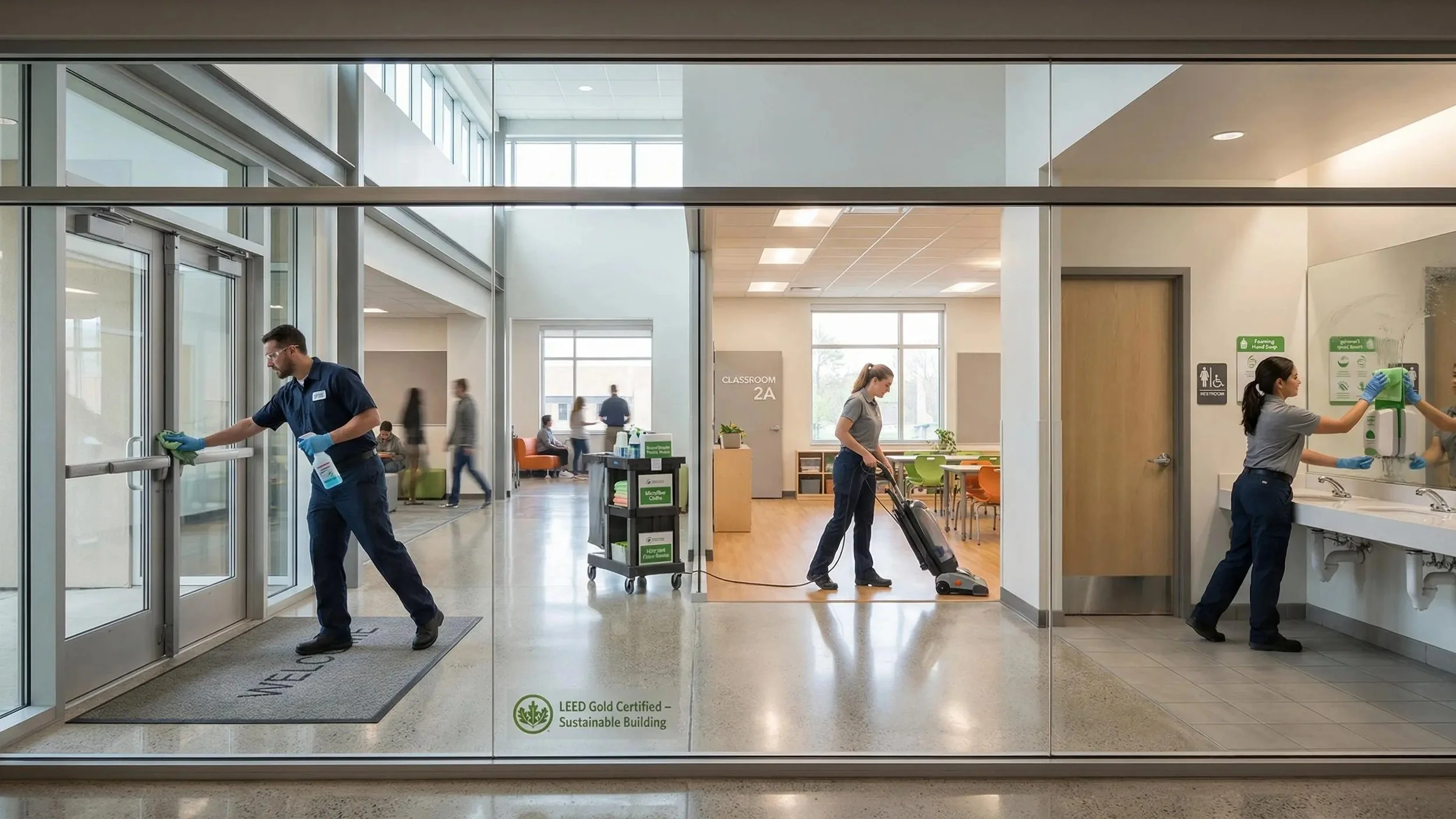
Daily: restrooms, shared surfaces, waste removal, entry mats
Weekly: floor edges, high dusting in active areas, stain treatment
Quarterly: high dusting where overhead buildup is a factor
Every 6 to 12 months: carpet extraction
1 to 2 times per year: VCT stripping and waxing
Annually: tile and grout restoration where wear and soil demand it
The checklist matters as much as the scope. Detailed job cards give crews a clear standard and help supervisors know what “done” actually means. They also help your day and night shifts stay aligned, which is one of those small operational details that prevents a lot of recurring issues.
If you’re relying on broad promises like “full cleaning provided,” you don’t really have visibility. You have hope. Facility leaders need a scope they can inspect against.
3. Use Green Cleaning Tools and Chemistry That Still Perform
There’s still a belief out there that green cleaning is gentler but weaker. In real buildings, that’s usually a product selection problem or a training problem, not a green cleaning problem.
Good enviro clean building maintenance services use environmentally responsible methods without giving up performance. The goal isn’t to be soft. The goal is to be precise.
That usually means using tools and products like:
Non-toxic, biodegradable cleaning chemicals where appropriate
Microfiber cloths and mops that capture soil more effectively than disposable materials
HEPA-filter vacuums to reduce fine dust and support indoor air quality
Energy-efficient equipment that lowers operating impact without slowing the work
In occupied commercial space, lower-emission products matter. Offices, schools, and healthcare environments don’t respond well to harsh smells, sticky residue, or chemical fog hanging in the air after service. People notice. By the second afternoon, you start hearing about headaches, odors, or surfaces that don’t feel clean even though they were “treated.”
That’s why green cleaning services work best when they’re run with discipline. Controlled dilution. The right dwell time. The right tool for the surface. Not extra product just because someone thinks stronger means cleaner.
For facilities tracking LEED-oriented goals, these practices also support broader sustainability targets. But even if you’re not chasing a formal certification, smart chemistry control is just better operations. Less waste. Fewer complaints. Better consistency.
4. Prioritize High-Touch Disinfection and Cross-Contamination Control
Not every surface needs the same level of attention. Some do.
High-touch points should be on a separate protocol, not buried inside a general wipe-down routine. That includes:
Door handles and push plates
Elevator buttons
Desks and shared workstations
Faucet handles
Conference tables
Restroom fixtures
Shared equipment and controls
Routine wiping is not the same as disinfection. Effective disinfection requires EPA-approved, hospital-grade products where appropriate, proper dwell time, and staff who understand what the label actually requires. If the surface is wiped dry too quickly, the chemistry may never do its job.
We also pay close attention to cross-contamination control. Color-coded cloths, mops, and chemicals sound basic, but they prevent a very real problem: restroom tools ending up in general-use areas, or breakroom surfaces being treated with the wrong equipment. In medical buildings, schools, and multi-zone facilities, that’s not a small miss.
There’s a balance here. Blanket over-disinfecting wastes labor and chemistry and doesn’t always improve outcomes. Targeted disinfection and sanitization services are usually the smarter move, especially in higher-risk spaces or during elevated illness periods. Electrostatic spraying can also be useful in the right setting when broader coverage is needed, but it should support a protocol, not replace one.
5. Protect Floors and Surfaces as Long-Term Assets
Floors take a beating, and they keep score.
Too many facilities treat floor care like a cosmetic extra until the carpet is gray in the traffic lanes, the VCT has worn through, or grout lines have turned into permanent stains. By then, you’re not maintaining assets. You’re trying to rescue them.
A smart floor program is preventive. That means matching service type and frequency to actual conditions:
Where the work pays off
Carpet extraction removes embedded soil that standard vacuuming leaves behind
Stripping and waxing protects VCT from wear, scuffing, and staining
Tile and grout restoration improves hygiene and appearance in wet or heavy-use spaces
Pressure washing helps maintain sidewalks, loading areas, and other exterior surfaces that collect buildup fast
Traffic, weather, soil load, and facility type all matter. Houston conditions are hard on entryways and exterior-adjacent surfaces. If mats are undersized or not maintained, that soil gets tracked deep into the building and starts wearing finishes down much sooner than expected.
There’s a safety side to this too. Residue buildup, damaged transitions, and neglected wet-area surfaces can all increase slip risk. So yes, deep cleaning and floor maintenance improve appearance, but the bigger win is preserving materials and avoiding premature replacement. Reactive maintenance compounds in the wrong direction.
6. Train In-House Teams Properly and Avoid Subcontracting Blind Spots
The quality of a cleaning program usually comes down to the people doing the work and how they’re managed. Everything else is secondary.
Facility managers should ask a simple question early: who is actually showing up in the building? With subcontracted labor models, that answer can get fuzzy fast. And when it gets fuzzy, supervision, consistency, and accountability usually go with it.
We believe trained W-2 employees are the better model for most commercial environments, especially sensitive ones. That means:
Background-checked staff
Standardized methods
Clear supervision
Better alignment with security and compliance expectations
Team cleaning also matters. When roles are specialized, crews move faster and more consistently than a one-person-does-everything setup. One person focused on restrooms, another on vacuuming and dusting, another on detail work. It’s not glamorous, but it works.
Don’t just ask what gets cleaned. Ask who’s cleaning it, how they were trained, and who’s checking their work.
Better training also reduces chemical misuse, missed tasks, and PPE mistakes. In a medical office, school, airport, or industrial site, those aren’t minor issues. They become operational risk.
7. Make Safety and Compliance Part of Everyday Cleaning
Cleaning crews can reduce risk or create it. There isn’t much middle ground.
In regulated, high-traffic, or secure facilities, cleaning has to fit the environment. That means safety and compliance can’t live in a binder somewhere. They need to show up in daily practice.
A solid program includes things like:
Monthly safety training
OSHA-informed oversight
Proper PPE use
Chemical handling procedures
Hazard communication and SDS access
Inspections and documentation
Lock-in and lock-out awareness
Restricted-area and entry-rule compliance
This is especially important in industrial plants, medical buildings, schools, airports, and secure office environments. A crew that doesn’t understand the site can miss a hazard, enter the wrong area, mishandle a chemical, or create a documentation gap that lands on your desk later.
That’s one of the quiet problems with low-visibility vendors. They may get through a shift without obvious issues, but if there’s an incident, missing paperwork and weak training become very visible very quickly. Compliance-minded cleaning isn’t about adding paperwork for the sake of it. It’s about reducing exposure before something goes wrong.
8. Track Quality With Audits, Logs, and Visible Accountability
If the only quality control system is waiting for complaints, you don’t have quality control.
Strong enviro clean building maintenance services build accountability into the work itself. Cleaning logs, inspections, job cards, and supervisor audits create a record of what was done, what was missed, and what needs adjusting. That matters even more across multiple shifts or larger buildings where problems can hide for days.
A good review process should regularly check:
Task completion
Touchpoint disinfection
Restroom condition
Supply restocking
Floor appearance and wear
Equipment readiness
Incident follow-up
Audits do more than catch missed work. They also reveal patterns like overuse of chemicals, weak procedures, equipment issues, or areas being serviced too often or not often enough. That gives facility managers something useful: proof.
And proof helps with budgets. When you can show recurring restroom traffic, entryway wear, or rising specialty floor care needs, it’s much easier to justify service adjustments before the building starts slipping backward. Strong QC reduces escalation because it catches drift early.
How to Evaluate an Enviro Clean Building Maintenance Partner
Price matters. It’s just not the first thing that should decide this.
When you evaluate a provider, look at how they operate under pressure, not how polished the proposal sounds. A strong partner should be able to explain, in plain language, how they’ll maintain standards without disrupting your facility.
Here’s the short list we’d use:
Do they customize scopes by facility type and risk level?
Are crews employees or subcontractors?
Are green cleaning methods proven in day-to-day operations?
Are disinfection protocols documented?
Can they support routine janitorial work and periodic specialty services?
Is there a clear quality control process?
Is safety leadership real, documented, and visible?
Also ask about communication cadence, issue resolution, and site security training. If daytime appearance or restroom resets are recurring pain points, day porter services may be worth evaluating too.
The lowest bid often leaves out the structure that makes the service work. Long-term partnership value comes from consistency, transparency, and fewer surprises.
Common Mistakes That Undermine Building Maintenance Results
Most building maintenance problems aren’t caused by one dramatic failure. They come from small weak decisions repeated for months.
We see the same mistakes over and over:
Choosing based on lowest cost instead of outcomes and oversight
Focusing on visible appearance while neglecting touchpoints and indoor air quality
Using harsh or excessive chemicals that leave residue or create odors
Applying the same schedule everywhere regardless of use or risk
Ignoring periodic maintenance until restoration costs climb
Relying on complaints instead of inspections
Underestimating training, security awareness, and safety discipline
Treating sustainability like marketing instead of daily practice
That’s the central issue. Strong enviro clean building maintenance services are structured, measurable, and preventive. Weak ones are reactive, vague, and inconsistent. The difference shows up in occupant confidence, asset condition, and how often your team has to chase problems after the fact.
Conclusion
The best enviro clean building maintenance services aren’t built around random tasks or surface-level appearance. They combine health-first cleaning, green methods that still perform, trained teams, proactive floor care, safety discipline, and visible quality control.
That approach gives facility leaders something valuable: less uncertainty. When cleaning is treated like an operational system, it protects people, preserves surfaces, supports compliance, and keeps the building working the way it should over time.
A practical next step is simple. Review your current scope, your inspection process, and your highest-risk areas. If those three things don’t line up, your maintenance program is probably asking the building to carry more risk than it should.