Housekeeping Facility Services: What They Include and Why
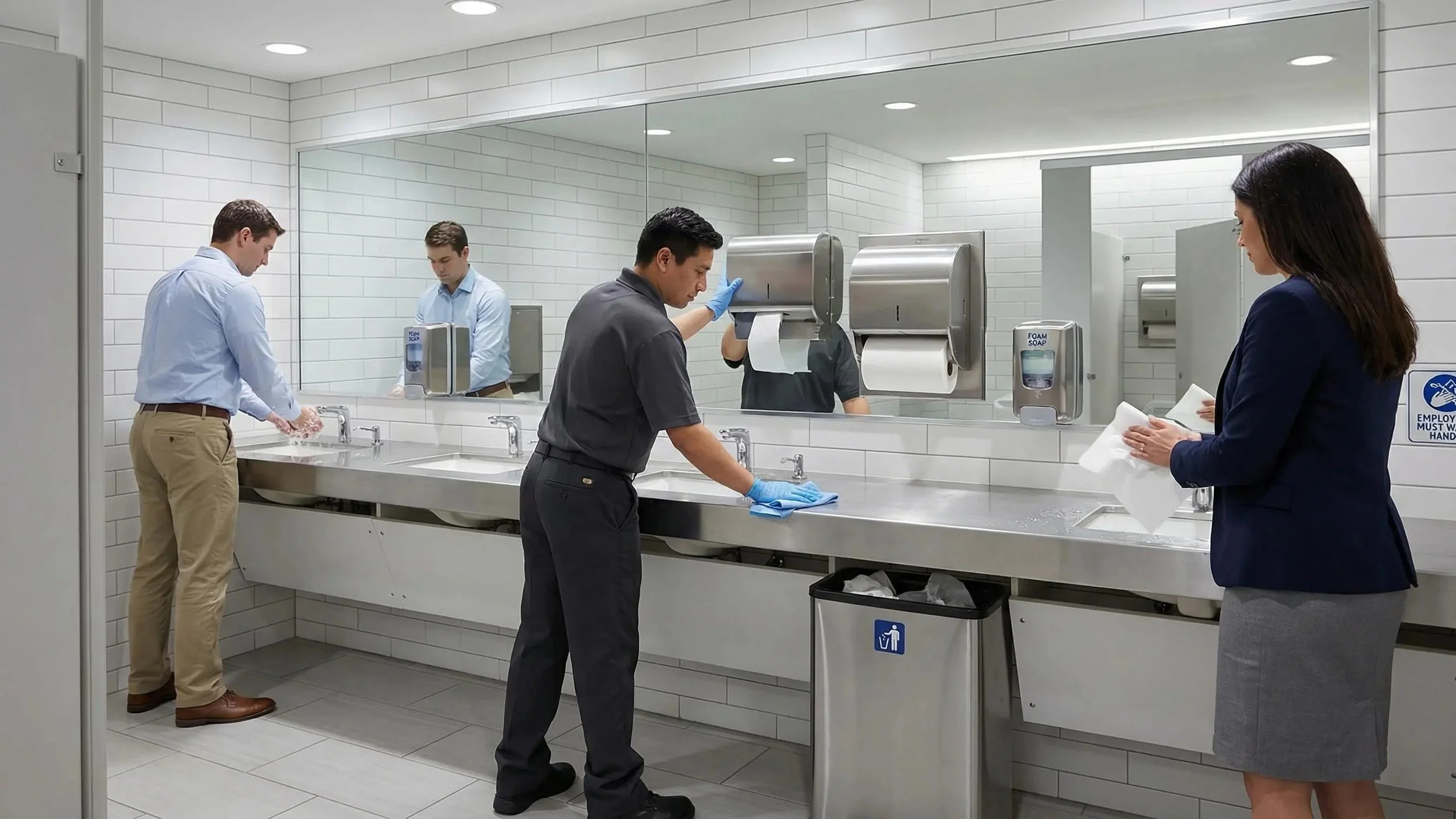
Housekeeping facility services look simple until you're the one dealing with missed restrooms, dull floors, and trash still sitting there by the 7 a.m. walkthrough. A lot of cleaning programs fail because they stop at surface tasks and never build a real system behind them.
What matters is not just what gets cleaned, but how often, how safely, and whether the work holds up in busy buildings. If you're managing an office, school, medical site, or warehouse, start here:
The gap between routine cleaning and deep cleaning usually shows up first in floors and restrooms.
High touch disinfection only works when products and dwell times match the space.
Weak staffing and sloppy checklists create more follow-up for you. Read this and spot the gaps fast.
What Housekeeping Facility Services Mean in a Commercial Setting
In a commercial building, housekeeping facility services are not just about keeping things looking neat. They’re the ongoing systems that keep a facility clean, sanitary, usable, and ready for the people moving through it every day.
That includes offices, schools, medical buildings, airports, industrial sites, churches, and similar properties. Different environments, same principle: cleaning has to support operations, not interrupt them.
A narrow janitorial mindset usually focuses on visible tasks. Empty trash. Mop floors. Wipe counters. That’s part of it, but it’s not the whole job. Real housekeeping facility services involve planning, schedules, documented frequencies, supply management, touchpoint disinfection, floor care, and clear quality standards.
A clean-looking building and a well-managed building are not always the same thing.
That gap shows up fast in high-traffic spaces. A lobby may look fine at 8 a.m., but if restrooms aren’t reset by midday, touchpoints aren’t disinfected, and spills sit too long, the operation starts to feel sloppy. Not because people don’t care, but because the system isn’t built right.
In most commercial settings, housekeeping also intersects with:
safety programs
infection prevention
indoor environmental quality
occupant confidence
brand and visitor perception
So when we talk about housekeeping facility services, we’re talking about a managed support function. The real value isn’t only what gets cleaned. It’s how reliably, safely, and consistently it gets done.
What Housekeeping Facility Services Typically Include
Most commercial programs cover the same core categories, but the right mix depends on traffic, building use, and risk. A school doesn’t need the same cadence as a corporate office. A medical site shouldn’t be cleaned like either one.
At the routine level, you can usually expect services such as:
dusting and surface wiping
vacuuming carpets and mats
mopping hard floors
trash and recycling removal
restroom cleaning and sanitation
cleaning breakrooms, lobbies, and shared spaces
interior glass cleaning in visible areas
restocking consumables where included in scope
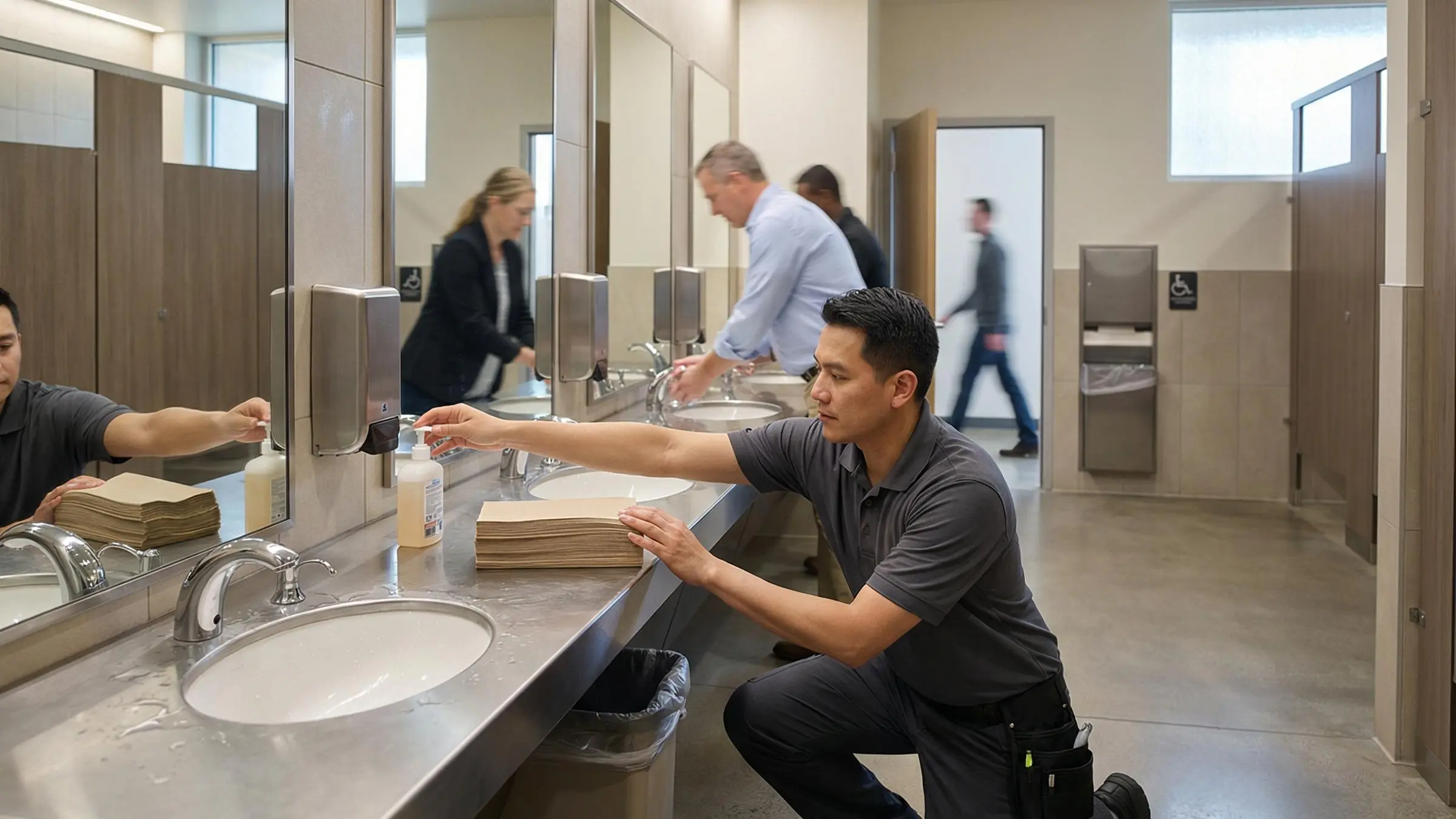
Restrooms deserve their own attention because they drive more complaints than almost any other area. Good service there means more than wiping fixtures. It includes sanitation, odor control, supply replenishment, and catching issues before they become building-wide complaints by the second afternoon.
High-touch disinfection is another major piece. Door handles, light switches, counters, desks, railings, elevator buttons, and shared equipment all need a defined process. If that process is vague, it usually doesn’t happen consistently.
Floor care is where many programs quietly fall apart. Daily vacuuming and damp mopping help, but they don’t replace a real floor maintenance plan. Carpet spot treatment, hard floor upkeep, and periodic restoration work all matter if you want flooring to last and still look right six months from now.
Busy facilities may also need day porter support for spills, restroom resets, lobby touch-ups, and traffic-related messes during operating hours. That’s especially true where appearance can slip between scheduled cleanings.
The main point is simple. Strong providers don’t run the same checklist everywhere. Frequencies and tasks should match the building, not the other way around.
The Difference Between Routine Cleaning and Deep Cleaning
Routine cleaning keeps the building presentable and hygienic day to day. Deep cleaning deals with what routine service won’t fully remove: embedded soil, buildup, high dust, stained grout, worn floor finish, and neglected detail areas.
You need both. One maintains the space. The other keeps the space from slowly degrading.
In practice, deep cleaning often includes work like:
VCT stripping and waxing 1 to 2 times per year
tile and grout restoration annually
high dusting on a quarterly cycle
Those aren’t arbitrary add-ons. They’re maintenance intervals. Skip them long enough and routine cleaning starts losing the fight. Floors stay dull. Odors hang around. Dust collects in places occupants notice even if they can’t name why the space feels off.
We see this a lot with flooring. A building team may assume nightly mopping is enough, but once the finish is worn down, daily care can’t bring it back. At that point you’re not maintaining the floor. You’re managing decline.
Deep cleaning also supports indoor air quality. High dusting, HEPA vacuuming, and targeted detail cleaning help reduce the fine dust and debris that routine passes tend to miss.
If you’re building a full housekeeping facility services program, deep cleaning and floor maintenance shouldn’t sit off to the side as “extras.” They belong in the plan.
Why These Services Matter Beyond Appearance
Appearance matters. It’s just not the main reason this work matters.
A solid housekeeping program reduces risk, supports daily operations, and protects the building itself. That’s the real frame.
Here’s where the impact shows up:
Health: targeted disinfection lowers exposure on shared surfaces and in restrooms
Safety: faster spill response and cleaner walkways reduce slip hazards
Productivity: your staff spends less time chasing avoidable building issues
Asset protection: floors, fixtures, and finishes last longer with proper care
Reputation: visitors, employees, patients, students, and inspectors notice the details
Sustainability: better products and methods reduce unnecessary chemical exposure
A building that feels consistently clean changes behavior. People trust it more. Complaints drop. Staff notices fewer distractions. That’s not fluff. It affects how the facility runs.
And the best programs do this quietly. They improve confidence without creating disruption.
Where Housekeeping Facility Services Need to Be Tailored
This is where generic cleaning programs usually get exposed. Facility type changes everything: staffing, training, scheduling, products, security procedures, even how crews move through the building.
Different buildings need different plans
Office buildings need secure access, reliable after-hours cleaning, and attention to restrooms, conference rooms, breakrooms, and touchpoints. In offices, inconsistency shows up fast because people use the same spaces every day and notice when standards drift.
Schools and colleges need heavy restroom and classroom disinfection, flexible scheduling around classes and events, and support for common areas that get worn down quickly. Schools can look under control at 7 a.m. and be completely different by lunchtime.
Medical facilities require a stronger infection-control mindset. That means hospital-grade disinfectants where appropriate, disciplined procedures for waiting rooms and exam-related spaces, and teams trained around CDC-aligned practices and HIPAA awareness where relevant. In medical environments, close enough is failure.
Industrial facilities bring PPE requirements, equipment considerations, production schedules, and safety risks that standard office crews are not prepared for. Cleaning around operations is a different skill than cleaning after operations.
Airports and transportation settings demand continuous upkeep, public-facing restroom care, seating area cleaning, secure-zone coordination, and documentation in a complex operating environment. The traffic never really stops.
Churches and religious buildings need respectful scheduling around services and community use, plus careful attention to gathering spaces where presentation and sanitation both matter.
A site-specific plan isn’t a premium feature. It’s the baseline if the provider understands the work.
The Operational Systems Behind Reliable Service
The difference between average and reliable service is usually invisible to the end user. Facility leaders feel it immediately.
Good housekeeping facility services run on structure. That means standardized checklists, job cards, defined task sequencing, and documented frequencies. People know what gets done, in what order, and how it’s verified.
At our level, we’ve learned something simple: if the work lives only in someone’s memory, it will fail under pressure.
That’s why team cleaning models matter. One person may handle restrooms, another vacuuming, another utility or light-duty detail work. When roles are clear, quality becomes more repeatable.
A few behind-the-scenes systems make a real difference:
color-coded tools to prevent cross-contamination
cleaning logs for accountability
internal inspections before the client has to complain
quality audits to catch drift early
defined chemical use and storage procedures
At PJS of Houston, our Innovative Cleaning System is built around that kind of discipline. Health-first cleaning, role clarity, green methods, and proactive quality control. Not because it sounds good, but because buildings don’t stay clean on good intentions.
Disinfection, Sanitization, and Cleaning Are Not the Same Thing
These terms get blurred all the time. They shouldn’t.
Cleaning removes soil, dust, and visible debris.
Sanitizing reduces certain bacteria to acceptable levels where applicable.
Disinfecting targets harmful microorganisms using the right product and the right dwell time.
If a surface looks clean, that does not automatically mean it’s been disinfected. That assumption causes a lot of false confidence.
High-touch surfaces deserve special attention in shared spaces. Door pulls, counters, shared desks, fixtures, switches, and restroom points of contact need deliberate disinfection protocols, not casual wipe-downs.
In higher-risk environments, EPA-approved and hospital-grade disinfectants may be appropriate. Some facilities also use electrostatic spraying as a specialized option when broad, even coverage is needed in certain situations. Useful tool, but still a tool. It doesn’t replace surface prep or routine process.
The right question is not “Are you disinfecting?” It’s “Where, how often, with what product, and under what risk conditions?”
That’s the health-first view. Cleaning for appearance is easy to promise. Cleaning for health takes more discipline.
Green Housekeeping Facility Services and Why They Matter
Green cleaning only works when it’s treated as an operating standard, not a label.
Done right, it reduces environmental impact and unnecessary chemical exposure without lowering cleaning quality. We’re talking about practical methods like biodegradable products, microfiber cloths and mops, HEPA-filter vacuums, and efficient equipment that supports better indoor air quality.
That matters in offices, schools, healthcare settings, and public facilities where occupant comfort and air quality are part of the experience. It also matters for organizations with LEED goals, ESG reporting pressures, or public accountability.
One common objection is that green products aren’t strong enough. Usually the problem isn’t the product. It’s poor process, weak dwell times, bad tool selection, or thin training.
A weak cleaning system doesn’t become strong just because the chemical is harsher.
Green housekeeping facility services should still be performance-driven. The standard is results. The difference is getting there with smarter methods.
What Facility Managers Should Look for in a Provider
A provider should make your job easier, not create a second job managing them.
Start with the workforce model. Are you dealing with trained in-house W-2 employees, or a revolving subcontracted crew? Direct staffing gives you tighter supervision, clearer accountability, more consistent training, stronger compliance, and fewer security questions.
Then look at the operating discipline:
documented inspections and service logs
clear issue-resolution process
safety training and PPE protocols
hazard communication practices
ability to customize by traffic and facility risk
responsive communication when something changes fast
Security matters too, especially in offices, schools, medical buildings, and industrial environments. You want a team that understands access control, background check expectations, and lock-in or lock-out procedures without constant reminders.
The best long-term partner usually isn’t the one with the flashiest pitch. It’s the one you don’t have to babysit.
Common Misconceptions About Housekeeping Facility Services
A few bad assumptions keep showing up in this industry.
Housekeeping is just basic cleaning.
Not in commercial settings. It’s an operational program tied to health, safety, and consistency.
All providers deliver roughly the same result.
They don’t. Training, staffing model, inspections, supervision, and safety controls change the outcome a lot.
If the building looks clean, it’s hygienic.
Visible appearance and actual disinfection are not the same thing.
Deep cleaning is optional.
Delay it long enough and you pay later through wear, odor, and corrective floor work.
Green cleaning is mostly marketing.
Not when it’s implemented properly. It supports air quality, occupant health, and sustainability goals.
The cheapest bid is the best value.
Cheap service often shifts the cost back onto your team through inconsistency, follow-up, security concerns, and wasted management time.
Signs Your Current Program Is Too Basic or Inconsistent
Sometimes the issue isn’t effort. It’s system design.
If your current housekeeping facility services are underperforming, the signs are usually pretty plain:
recurring restroom complaints
odors or trash issues despite regular service
floors that never seem to recover
missed touchpoints, corners, vents, or buildup areas
different results from one shift or week to the next
little or no documentation
too much follow-up from your staff
sloppy chemical handling or inconsistent PPE use
unfamiliar workers showing up in sensitive spaces
One of the clearest signals is this: your team spends too much time checking whether basic tasks were actually completed. That’s not a labor issue alone. That’s a control issue.
How a Strong Program Supports Control Without Constant Oversight
Most facility leaders aren’t looking for more cleaning talk. They want fewer surprises.
A strong program creates control through documented scope, audit routines, quality checks, and clear escalation paths. That structure reduces the need for constant client involvement because accountability is already built in.
In higher-traffic environments, day porter services can add another layer of stability. Spills get handled fast. Restrooms stay presentable. Entrances don’t drift halfway through the day. You keep the building under control while business keeps moving.
Teams also need to understand site-specific security procedures. Access restrictions, lock-in and lock-out practices, and secure-zone rules shouldn’t be improvised by whoever happens to be on shift.
Consistency is what gives you back your time. When the system works, you can focus on operations instead of chasing cleaning problems from one side of the building to the other.
Conclusion
Housekeeping facility services cover far more than visible cleaning. In a commercial environment, they include routine janitorial tasks, disinfection, deep cleaning, floor care, safety-conscious procedures, restocking support, and environmentally responsible methods that protect the building and the people in it.
That’s the real takeaway. Effective housekeeping is not a set of isolated tasks. It’s a managed system that supports health, safety, presentation, and asset life.
If you’re evaluating your current program, look past whether the space appears tidy at first glance. Ask whether the service is structured, documented, adaptable, and reliable enough to support your operation without constant oversight.
That’s usually where the difference is. Not in the promise. In the system behind it.