The Complete Guide to Standard Operating Procedures for Cleaning
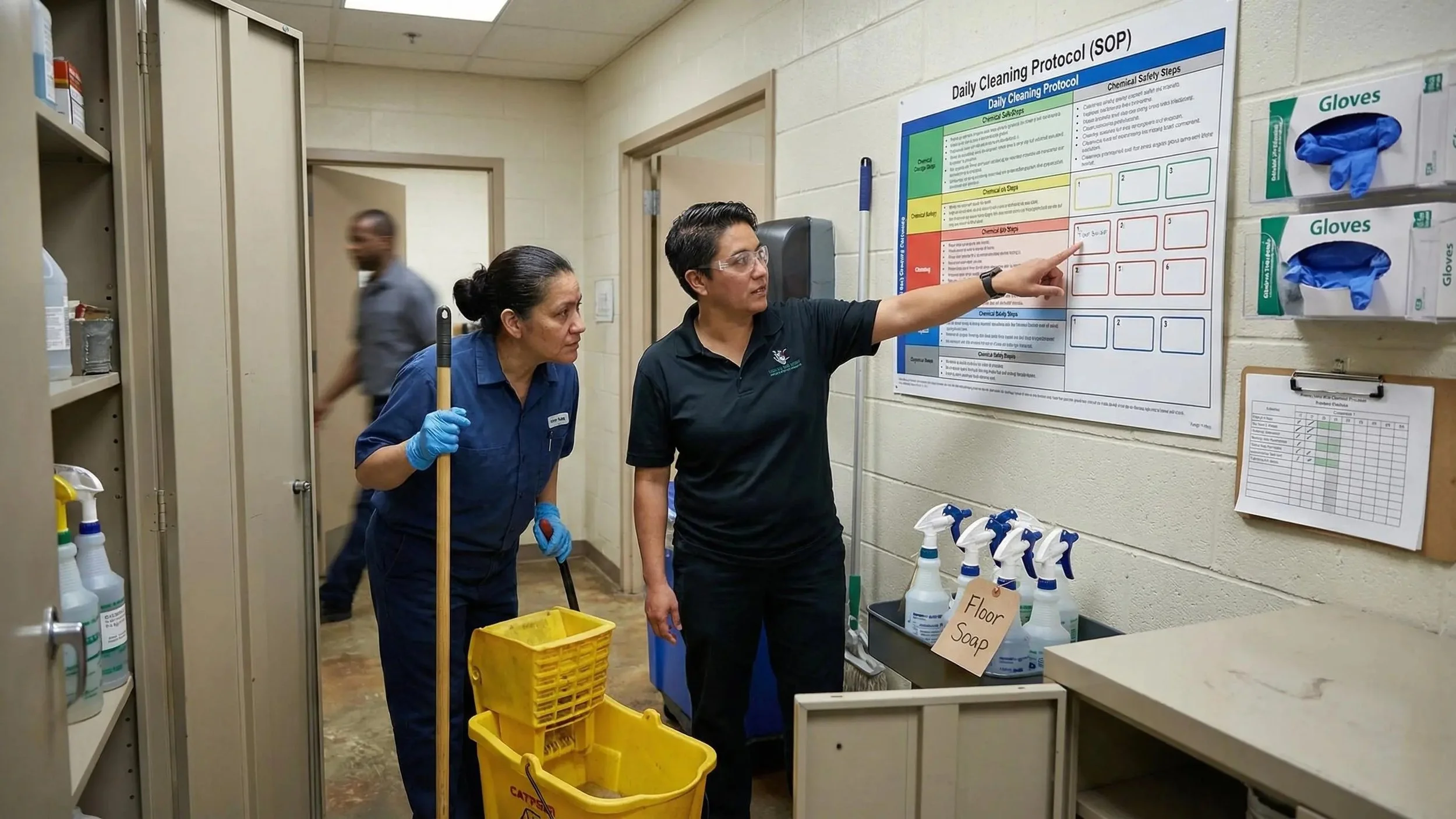
Standard operating procedures for cleaning sound boring until a restroom gets skipped, a disinfectant gets wiped too fast, or two crews do the same job two different ways. If you're managing a facility, that's where the trouble starts.
What matters is simple: clear steps, clear ownership, and a standard your team can actually check at 6 a.m. before the building fills up. That's the difference between "looks fine" and work that holds up.
A few things operators usually learn the hard way:
A checklist alone won't stop missed dwell times or bad chemical use.
Night shift drift shows up first in restrooms, touch points, and floors.
If nobody can verify the method, you're stuck chasing complaints later.
What Standard Operating Procedures for Cleaning Actually Mean
Standard operating procedures for cleaning are the written instructions that make cleaning repeatable. They spell out what gets cleaned, how it gets cleaned, when it happens, who owns it, and what acceptable results look like.
That sounds simple. It usually isn't.
A real SOP is more than a task list. It should define:
the sequence of work
the tools and equipment required
the chemical and dilution to use
safety precautions and PPE
frequency
the quality standard at the end
A cleaning schedule tells you when something should happen. An inspection form tells you whether it passed. Training notes help someone learn the job. A scope of work defines what service is included. Standard operating procedures for cleaning sit underneath all of that. They're the operating backbone.
In commercial facilities, that's the difference between a process and a habit.
When SOPs are done right, they support onboarding, supervisor oversight, facility-specific plans, audits, corrective action, and daily execution across shifts. We look at them as part of protecting health, safety, and trust. Not paperwork. A building can look fine and still be poorly cleaned.
If your standard lives in someone's memory, you don't have a standard.
Why Commercial Facilities Need SOPs Instead of Verbal Instructions
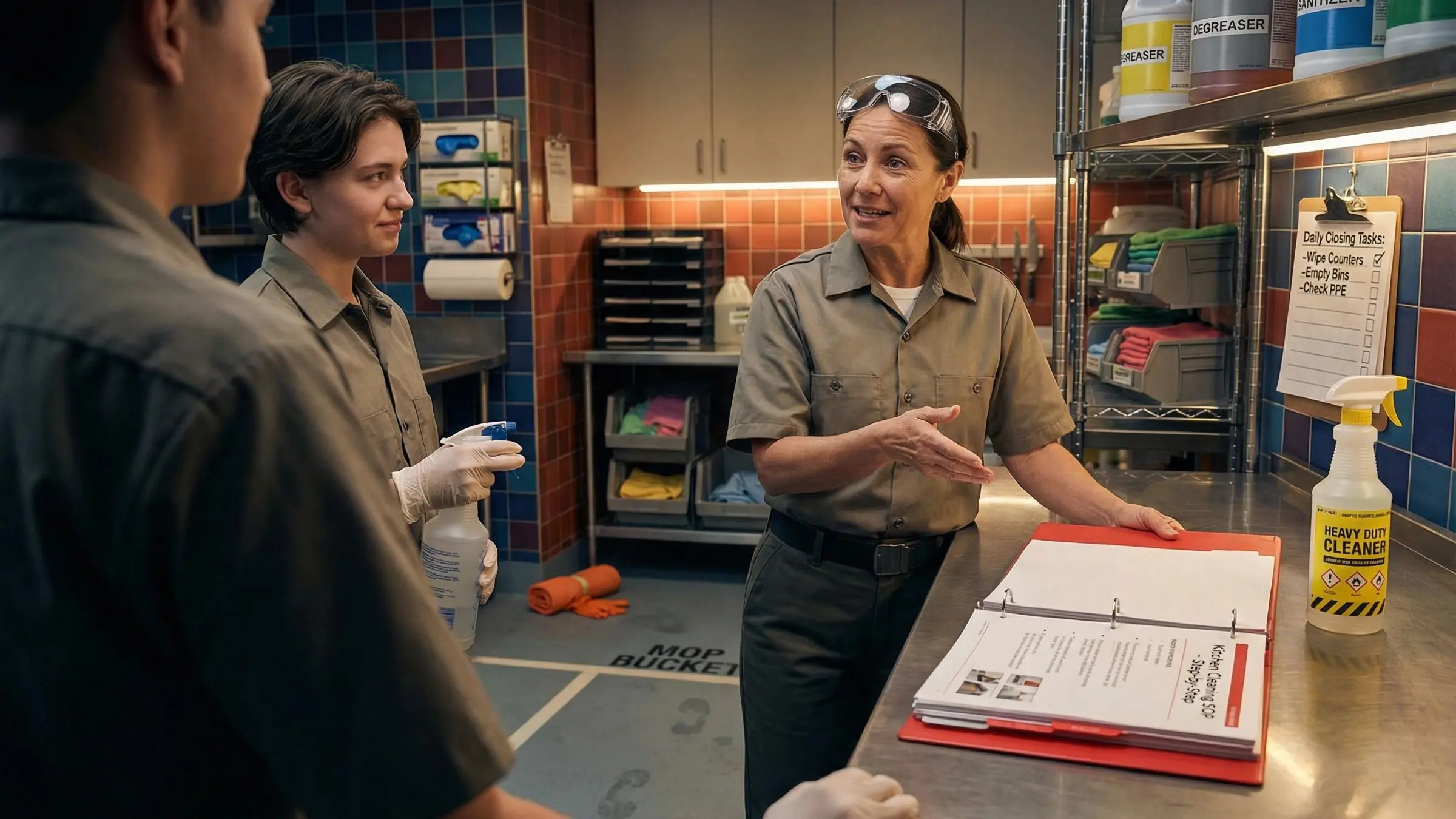
Most facility managers have seen the same pattern. Things run well for a while, then quality starts drifting. One shift handles restrooms one way, another shift cuts corners on touch points, and by the time complaints show up, you're already behind.
Verbal instruction works until it doesn't.
Inconsistency shows up in very practical ways:
uneven restroom presentation from one day to the next
missed high-touch disinfection in shared areas
wrong chemical used on the wrong surface
floors that are technically mopped but still unsafe or poorly finished
complaints that could have been prevented with clearer process
The risk gets worse when you have multiple crews, overnight work, sensitive spaces, or more than one facility to manage. In schools, medical buildings, airports, and industrial sites, undocumented standards create avoidable exposure. Not just to complaints, but to safety issues, security mistakes, and operational disruption.
SOPs reduce that uncertainty. They give your team and your cleaning partner the same playbook. That means less chasing, fewer assumptions, and more confidence that critical work is getting done the right way.
A health-focused janitorial program should be visible and measurable. Otherwise you're managing by hope.
The Core Elements Every Cleaning SOP Should Include
If an SOP leaves out the details that affect safety or quality, crews fill in the gaps on their own. That's where drift begins.
At minimum, each procedure should include the following:
Purpose
Why this procedure exists and the outcome it's meant to protect.
Scope
The room type, surface, area, or task it applies to.
Roles and responsibilities
Assign ownership by position, such as cleaner, lead, supervisor, or day porter.
Required PPE and safety controls
Gloves, eye protection, signage, lockout precautions, or access restrictions.
Chemicals and dilution requirements
Include concentration rules and whether testing is required.
Tools and equipment
Spell out what is used, including color-coded tools to reduce cross-contamination.
Pre-task setup
Secure the area, stage supplies, post wet floor signs, check equipment.
Step-by-step method
Use clear, active language in the order the task is performed.
Dwell time where needed
Especially for disinfectants. A fast wipe is not disinfection.
Frequency
Daily, weekly, monthly, after use, or event-driven.
Quality standard
Define what done looks like.
Documentation method
Log sheet, job card, digital record, sign-off.
Revision control
Make sure the current version is the one in use when products or methods change.
The non-obvious part is revision control. A lot of teams forget it. Then six months later the crew is still following instructions built around a product you no longer stock.
What a Strong Cleaning SOP Covers That a Basic Checklist Misses
Checklists are useful. We use them. But a checklist confirms completion. An SOP defines the right method.
That distinction matters more than people think.
A restroom checklist might say "disinfect touch points." The SOP should define the product, the order of work, the required dwell time, and the final inspection standard. A floor checklist might say "mop floor." The SOP should explain soil removal, solution choice, and slip prevention steps. Same task on paper. Very different result in the field.
Here's the simplest way to separate them:
SOP = how to do the work correctly
Checklist = whether the work was completed
Audit = whether the process and result hold up over time
Used together, they form a cleaning accountability framework. Used alone, each has a blind spot.
A checklist without a procedure gives you false confidence. We've seen spaces signed off as complete where dwell time was skipped, tools were cross-used, and the room still "looked clean."
The Types of Cleaning SOPs Most Commercial Facilities Need
Not every facility needs the same stack of procedures, but most commercial sites need more than one general cleaning SOP.
The common categories include:
Facility-specific cleaning plan SOPs for room types, frequencies, access rules, and special conditions
Restroom cleaning SOPs for sequencing, restocking, touch-point disinfection, floor finishing, and inspection
High-touch disinfection SOPs for handles, switches, desks, rails, and buttons
Floor care SOPs for daily care, scrubbing, recoating, stripping, carpet extraction, and tile or grout restoration where needed
Waste handling SOPs for removal, segregation, liner changes, and safe handling
Chemical handling and dilution SOPs for labeling, PPE, storage, mixing, and spill response
Equipment use SOPs for vacuums, auto scrubbers, electrostatic sprayers, and specialty tools
Day porter SOPs for occupied-space support, touch-up work, and visible issue response
Emergency cleaning SOPs for spills, floods, biohazards, and urgent sanitation needs
Security and access SOPs for restricted areas, lock-in and lock-out, and unauthorized entry prevention
If you only document the routine work, the highest-risk moments stay unmanaged. That's usually where the real trouble starts.
How to Build SOPs That Work Across Different Facility Types
One generic SOP set rarely holds up across offices, schools, medical spaces, industrial sites, airports, and churches. The framework can stay consistent. The methods can't.
Different sites carry different pressures:
Offices
You need quiet work, secure access, and minimal disruption. After-hours cleaning changes how supplies are staged and how issues are reported.
Schools
Schedules move fast. Shared surfaces, classrooms, restrooms, and common areas need tighter sanitization routines and more flexibility around occupancy.
Medical facilities
Infection control discipline matters more, and documentation gets stricter. You can't rely on broad instructions in sensitive areas.
Industrial facilities
PPE, machinery awareness, and production coordination need to be built into the procedure. Floor care can also be a safety issue, not just an appearance issue.
Airports and high-traffic hubs
Speed matters, but so does reporting discipline. Secure access and visible cleanliness have to coexist.
Churches and similar spaces
These spaces often require schedule sensitivity and respectful conduct along with standard cleaning performance.
We've worked across these environments, and the lesson is consistent: standardize the structure, customize the execution. That's where experience across industries becomes operationally useful.
How to Write SOPs So Crews Actually Follow Them
A procedure nobody uses is just a binder with good intentions.
Write SOPs from the crew's point of view. Use direct language. Put the action first. Avoid vague words like should when must is what you mean. Organize steps in the order the task actually happens, not the order they came up in a meeting.
A few rules make a big difference:
keep instructions concise
match the wording to how the team is trained
use visuals when equipment setup or supply placement matters
account for real conditions like after-hours work, occupied spaces, and time pressure
test understanding during onboarding and refreshers
One practical mistake we see often is writing procedures for ideal conditions. Real work happens when a hallway is still occupied, a restroom is low on supplies, or an auto scrubber battery didn't hold. Good SOPs account for those conditions without becoming bloated.
If crews need a supervisor to translate the document every time, the document isn't finished.
The Right Sequence for Cleaning and Sanitizing
Sequence matters because bad order creates rework, cross-contamination, and wasted labor. It also creates the illusion of completion.
In most room types, the broad logic is simple: top to bottom, clean to dirty, floors last.
That doesn't mean every space is identical, but the sequence should usually follow this order:
Prepare the area and supplies
Remove trash and visible soil
Clean the surface with the correct product
Apply disinfectant where required
Allow proper dwell time
Wipe, rinse, or finish based on product and surface
Complete floors last when appropriate
Conduct a final inspection
The cleaning-versus-disinfecting distinction matters here. A wiped surface may look better and still not be sanitized. In restrooms especially, sequence is everything. If the crew handles the dirtiest areas too early or skips final floor timing, the room can be re-soiled before they leave it.
Health-focused cleaning programs don't leave sequence to interpretation. That's one of the quiet reasons they stay more consistent.
Safety Requirements That Must Be Built Into Cleaning SOPs
Safety isn't separate from cleaning quality. If the work is unsafe, the work is not under control.
Your SOPs should include PPE by task, chemical labeling rules, Safety Data Sheet access, hazard communication steps, safe storage, spill response, equipment precautions, and wet floor controls. In industrial or complex facilities, they also need to address working around machinery, utilities, and sensitive systems.
This is where safety performance measures become useful, not as a reporting exercise but as an operating signal. Track things like:
training completion
PPE compliance
chemical handling violations
incident and near-miss trends
corrective action closeout
Monthly safety topics and documented inspections help keep procedures alive. Without that follow-through, even a good SOP starts fading by the second month.
Dedicated safety oversight matters in more complex environments. Not because it's impressive. Because assumptions around chemicals, surfaces, and equipment can create risk fast.
The Role of a Cleaning Accountability Framework
A cleaning accountability framework connects the written procedure to daily execution and proof. It ties together SOPs, checklists, staffing roles, logs, supervisor reviews, and issue resolution.
Accountability is not just knowing who cleaned the space. It's being able to verify the standard, timing, and method.
A workable framework usually includes:
clear task ownership by role
daily and periodic checklists
site-level job cards or work instructions
supervisor inspections and quality audits
visible logs or digital records
escalation paths for missed work
documentation available for client review when needed
At PJS of Houston, job cards, quality control, and proactive inspections are part of keeping standards visible. That matters because complaint-driven management is exhausting. A strong framework catches drift before occupants do.
How to Audit SOP Compliance Without Creating More Administrative Burden
Auditing should confirm outcomes and catch drift early. It shouldn't bury your team in paperwork.
There are different levels to it. Routine spot checks look at immediate conditions. Formal quality inspections review broader consistency. A health and safety compliance audit goes further into process, records, chemical handling, PPE, and training support.
You need to audit both outcome and method. A space can look clean while the team is still missing labels, skipping dwell time, or using the wrong tools.
Review items such as restroom condition, floor finish, high-touch sanitation, chemical storage, PPE use, logs, color-coded tool discipline, security steps, and relevant training records. Then tie findings to coaching, retraining, or procedure updates.
Don't just issue reminders. Fix the process that made the reminder necessary.
Metrics That Show Whether Your SOPs Are Working
Standard operating procedures for cleaning should improve performance you can actually see. Not just document control.
Useful metrics include inspection pass rates, repeat complaint frequency, task completion accuracy, rework, sanitation consistency in restrooms and high-touch areas, supply usage, training completion, and retention of procedures. Safety performance measures should also be part of the picture, especially PPE compliance, chemical handling issues, and hazard correction follow-through.
In high-traffic or secure facilities, response times and verified completion records can matter just as much as visual results.
Keep the metric set manageable. If you track too much, people stop paying attention. If you track nothing, you're guessing.
Common SOP Mistakes That Lead to Inconsistent Cleaning
Most SOP failures are predictable. The document is vague, too long, too generic, outdated, or disconnected from actual work.
The common mistakes look like this:
unclear instructions such as "clean thoroughly"
missing dwell times, dilution rules, or PPE requirements
no definition of acceptable quality
relying on verbal training alone
using one generic SOP set across very different facilities
no document control when products or methods change
no audit loop
no role clarity between staff, leads, and supervisors
focusing only on appearance while ignoring health, safety, environmental responsibility, and security
A clean-looking facility can still be poorly managed. That's the trap.
How to Implement SOPs Across a New or Existing Facility
Start with a facility assessment. Look at room types, traffic patterns, risk points, compliance needs, access limitations, and cleaning frequency. Then build site-specific procedures from the real scope of work, not a generic template alone.
Before rollout, align your products, tools, PPE, and storage setup with the written procedure. Train by role and task. Then verify understanding through observation, not just sign-in sheets.
For the first few weeks, tighten supervision. Use daily checklists and supervisor review to catch gaps early. After that, move into recurring quality inspections and a regular health and safety compliance audit cadence. Update procedures when occupancy, equipment, building use, or exposure changes.
Routine janitorial services and day porter support are strongest when the procedure is already built underneath the work.
When to Standardize In-House and When to Partner With a Commercial Cleaning Provider
Some organizations keep cleaning in-house. Some outsource fully. Some use a hybrid. The right call depends on complexity and management bandwidth.
Ask yourself a few direct questions:
How many facilities and shifts are we managing?
How complex are our compliance expectations?
Do we need specialty support like disinfection, floor maintenance, or emergency cleaning?
Can our team handle training, audits, and corrective action consistently?
Are staffing stability and security concerns becoming operational issues?
If consistency matters, be careful with any model built around weak supervision or unstable labor. Structure matters. So does documented training and safety oversight.
A commercial cleaning partner should bring systems, transparency, and site-specific execution. Not just bodies on a shift.
What Decision-Makers Should Ask Before Approving or Revising Cleaning SOPs
Before you approve or revise anything, pressure-test the procedure against the building you actually operate.
Ask:
Are these SOPs specific to this facility type and occupancy pattern?
Do they clearly define methods, frequencies, products, safety rules, and quality standards?
Can supervisors verify compliance without relying on memory?
Are high-risk areas and high-touch surfaces addressed directly?
Is there a clear cleaning accountability framework with logs, inspections, and corrective action?
Are safety performance measures tracked and reviewed?
How often are procedures updated?
Do staff receive documented training and refreshers?
Could we produce records during a health and safety compliance audit?
Are security and access procedures built into the work?
If those answers are weak, the cleaning program is weaker than it looks.
Conclusion
Standard operating procedures for cleaning are what turn cleaning into a dependable operating system. They create consistency across people, shifts, and facility types by defining method, ownership, safety controls, quality expectations, and accountability.
Reliable cleaning doesn't come from effort alone. It comes from clear procedures, role clarity, documented follow-up, and regular auditing. That's how you protect health, reduce surprises, and stop managing quality after the complaint.
If you're looking for a place to start, pick one high-risk area first. Restrooms. High-touch disinfection. Chemical handling. Tighten the SOP there, then expand.
And if your facility needs stronger documentation, better quality control, or health-focused janitorial support, a structured commercial cleaning partner can help you build a system you can trust.