7 Facility Management Cleaning Tips for Safer Sites
facility management cleaning falls apart when everything gets treated the same. You already know the result: missed touchpoints, dirty entrances by 10 a.m., and restrooms that look fine until people start complaining.
What matters is control, not more random labor. The best cleaning plans follow risk, traffic, and building use, because a school, medical office, and warehouse do not break down the same way.
Get that right, and your site stays safer with fewer surprises.
1. Start With a Risk-Based Cleaning Plan, Not a Generic Schedule
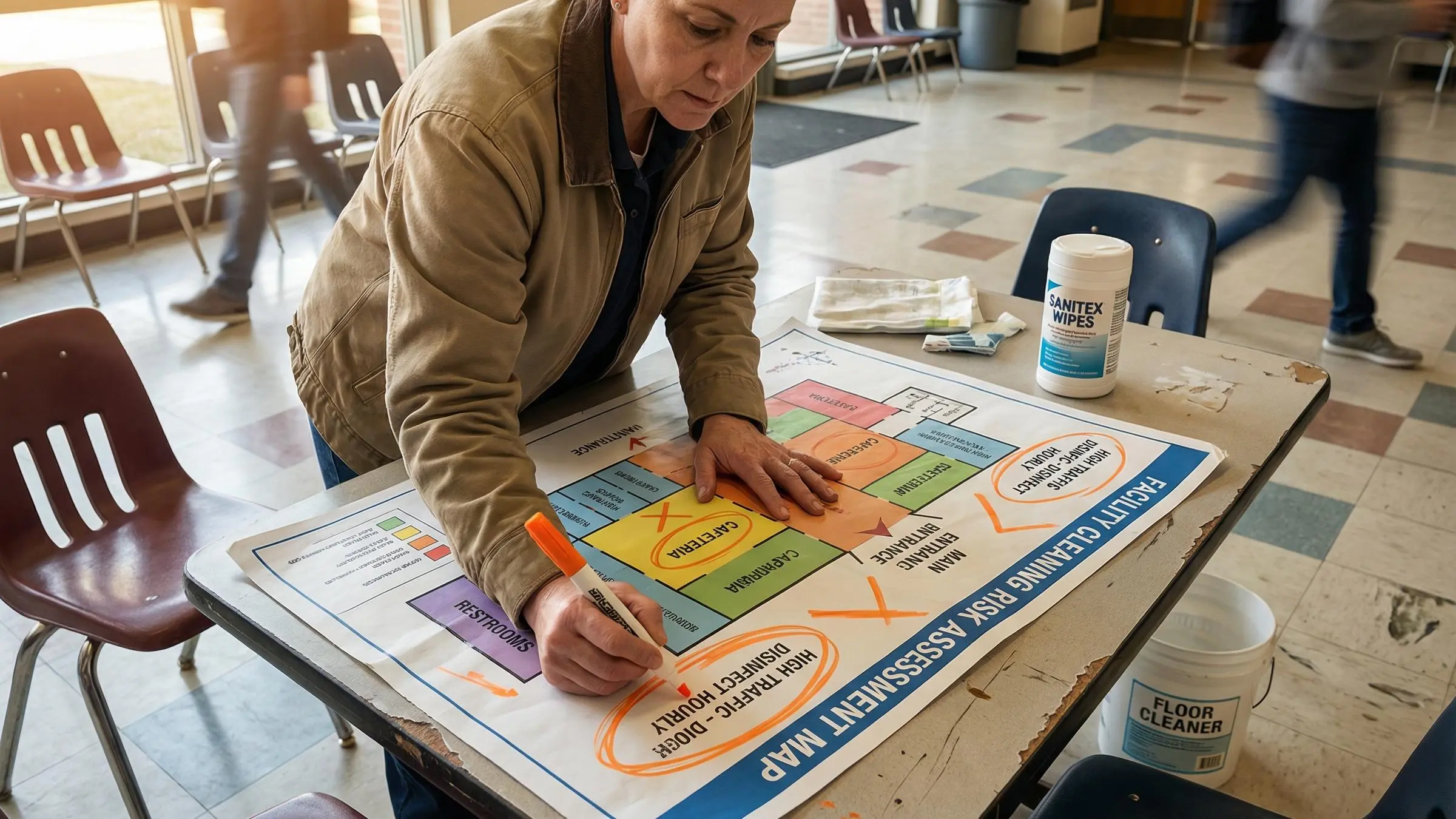
A lot of facility management cleaning programs break down for one simple reason. They’re built around a calendar instead of the building. That sounds organized, but it usually misses how the site actually functions.
Cleaning in a commercial facility is an operating system. It affects safety, hygiene, appearance, and uptime. If the plan doesn’t reflect traffic, use patterns, and contamination risk by zone, you end up over-cleaning quiet spaces and missing the areas that matter most.
Break the site into zones and treat them differently:
entrances and lobbies
restrooms
break rooms
classrooms
waiting areas
production-adjacent spaces
loading docks and service corridors
A waiting room with constant turnover doesn’t need the same approach as a locked records room. An airport concourse won’t behave like an office suite. A school changes by the hour, and then changes again during events. In industrial buildings, dust, grease, and residue near equipment can turn into both a safety issue and a maintenance problem if nobody plans for it.
We’ve found that risk-based facilities cleaning and maintenance works better when task frequency is documented clearly across timeframes:
weekly for detailing, lower-traffic zones, and spot floor care
monthly for more complete surface attention
quarterly for high dusting and other periodic needs
annually for restorative work
Deep cleaning belongs in the plan from day one. Carpet extraction, tile and grout restoration, floor refinishing, and high dusting should never be treated like emergency catch-up work.
A generic schedule gives you motion. A risk-based plan gives you control.
2. Prioritize High-Touch Disinfection Where Health Risk Is Highest
Not everything that looks clean is safe. That’s where a lot of programs get fooled.
Cleaning for appearance removes visible soil. Disinfecting for health reduces microbial risk. Those are related, but they are not the same job. If your team treats them like they’re interchangeable, you’ll get shiny surfaces and lingering exposure.
High-touch surfaces need tighter attention, especially during illness season, occupancy surges, or in sensitive environments. That usually includes:
door handles and push plates
elevator buttons
restroom fixtures
desks and shared workstations
railings
touchscreens
break room counters, tables, and appliance handles
shared equipment controls
The right product matters. So does the dwell time. We use EPA-approved, hospital-grade disinfectants because product selection is only half the job. If the surface isn’t kept wet for the required contact time, the disinfectant may not do what you think it’s doing. That mistake is common. It also stays invisible until complaints or illness trends start rising.
In some settings, electrostatic spraying can add value for broader coverage. It’s useful when a facility needs more comprehensive disinfection support, but it shouldn’t replace proper manual cleaning of high-touch points.
Good cleaning and facility management teams don’t disinfect every inch with the same intensity. They adjust frequency based on traffic, shared use, and occupant vulnerability. That’s how you reduce risk without wasting labor.
3. Prevent Cross-Contamination With Standardized Tools and Task Separation
Cross-contamination is one of the quiet failures in facility management cleaning. The building can look fine and still have bad process behind it. That’s not a small issue in restrooms, food areas, medical spaces, or shared work environments.
The fix is structure.
Color-coded cloths, mop heads, tools, and chemicals create simple boundaries crews can follow under pressure. Restroom tools should never show up in office space or a break room. High dusting tools used on ledges and vents shouldn’t get mixed into touchpoint cleaning. Spill response supplies need to be staged and ready, not improvised from whatever is on the cart.
This is where standardized task separation helps. Instead of assigning a person to “clean this whole area,” stronger teams separate work by function. One person handles vacuuming, another restroom sanitation, another light-duty detailing, another utility support. It improves speed, but more importantly, it improves consistency.
A few examples matter here:
Restroom sanitation should stay completely isolated from food-service-adjacent spaces.
Tools used above shoulder height should not roll straight into desk and counter cleaning.
Spill kits need to be accessible before the spill happens. After is too late.
People notice visible dirt. They usually don’t notice poor sanitation flow. But they feel the results when odors linger, illness spreads, or standards shift between crews.
That’s why standardized methods matter in facilities cleaning and maintenance. They reduce variation, protect occupants, and make quality less dependent on who happened to work that shift.
4. Keep Floors, Walkways, and Work Areas Continuously Safe
Floor care is a safety issue first. Appearance comes second.
Slips, trips, and falls stay on the list because small things get ignored. A little moisture at an entrance. Fine dust along a corridor edge. Shrink wrap scraps near a dock door. By the second afternoon, those “small things” become incident potential.
One basic rule gets missed all the time: you can’t mop dirt effectively. Dry soil has to come off first through sweeping, dust mopping, or vacuuming. If that step is skipped, wet cleaning just moves soil around and turns it into residue.
Different surfaces need different plans. Carpet, VCT, tile, grout, and concrete all wear differently, and wear patterns rarely match the floor plan on paper. Entrances and main corridors tell the truth fast. So do industrial aisles with tracked-in grime or oil residue around work zones.
Periodic care protects both safety and asset life:
Carpet extraction every 6 to 12 months
VCT stripping and waxing 1 to 2 times per year
Annual tile and grout restoration
Quarterly high dusting so particles don’t settle back onto floors and surfaces
In warehouse and industrial settings, expansion-joint buildup, residue near equipment, and dusty corners along racking are worth watching closely. They don’t stay contained.
Clean floors also depend on organization. Shelving, designated waste areas, and controlled storage reduce clutter before it becomes a trip hazard. Good floor care isn’t just what your crew does with a machine. It’s how the space is managed between cleanings.
5. Build Cleaning Around Safety Compliance and Chemical Control
Safer sites don’t happen because a crew works hard. They happen because the work is controlled.
Visible cleanliness is only part of the job. Behind it, there should be a real safety program: hazard assessment before tasks begin, proper PPE, clear chemical labeling, SDS access, emergency procedures, and training that matches the environment.
That becomes more important in medical, industrial, and transportation settings, where crews may be working around machinery, restricted areas, or hazardous materials. Those sites don’t leave much room for guesswork.
When we evaluate a cleaning program, these are the basics we expect to see:
task-level hazard awareness
PPE selected for the actual exposure
training for spills and emergency response
site-specific rules for secure or regulated areas
equipment safety practices backed by supervision
OSHA-aware execution matters in everyday work, not just during audits. Gloves, eyewear, machine handling, dilution control, wet floor procedures, lockout boundaries around equipment, all of that shows up in routine cleaning.
Emergency response capability matters too. Floods, spills, and biohazard events don’t care what the nightly scope says. If your provider can’t shift from routine service to urgent containment, you’ve got a gap.
When you’re comparing cleaning facility management companies, don’t just ask how many people they can send. Ask how they run safety in the field.
6. Use Checklists, Job Cards, and Audits to Make Quality Verifiable
One of the biggest frustrations in facility management cleaning is inconsistency. Monday looks great. Wednesday is uneven. Friday depends on who showed up.
That usually means the system is relying too much on memory and not enough on documentation.
Detailed job cards and checklists turn expectations into repeatable work. They should spell out zone-by-zone tasks, frequency, site-specific instructions, logs, inspection results, and corrective actions. If an issue is found, there should be a record of what changed after that. Otherwise the same problem tends to circle back.
What strong documentation actually does
It gives supervisors something concrete to inspect. It gives crews a clear target. It gives facility managers proof.
A good audit process should be proactive, not complaint-driven. If leadership only hears about cleaning after an occupant complains, the quality program is already late. Supervisors and quality control staff should be catching drift early, retraining where needed, and confirming completion with documentation.
Vague impressions are not enough. “The building looks okay” doesn’t help much during a budget review, service dispute, or internal audit. Measurable standards for restrooms, entrances, floors, shared spaces, and touchpoints do.
For outsourced cleaning and facility management partnerships, transparency is a differentiator. You shouldn’t have to guess whether service happened. You should be able to verify it.
7. Choose Sustainable Methods That Support Health and Long-Term Performance
Green cleaning only matters if it performs. Facility managers know that fast.
We look at sustainability as a health and operations strategy, not a branding exercise. Non-toxic and biodegradable chemicals, microfiber systems, HEPA-filter vacuums, and energy-efficient equipment can reduce residue, limit chemical exposure, and support indoor air quality. That matters in offices, schools, churches, and healthcare-adjacent environments where occupants are in the building for long stretches.
The tradeoff is straightforward. Safer chemistry is only useful if hygiene standards still hold. Products and methods have to work in the real building, on the real soils, under the real schedule.
A mature facilities cleaning and maintenance program balances both sides:
strong cleaning performance
lower unnecessary chemical burden
support for indoor air quality
less wear on finishes and materials
alignment with LEED or broader sustainability goals where relevant
We’ve seen one practical benefit show up over time. When methods are selected carefully, surfaces hold up better. Floors keep their finish longer. Dust control improves. Occupants notice the air before they notice the product label.
That’s the right order.
What to Look for in Cleaning Facility Management Companies
Price matters, but it’s rarely the whole story. Staffing promises aren’t enough either.
When you’re evaluating cleaning facility management companies, look closely at how the workforce is structured. Direct-hire W-2 staffing usually gives you better accountability, more consistent training, clearer supervision, stronger workers’ compensation coverage, and tighter background screening than subcontracted labor. In controlled-access buildings, that difference matters.
Use these decision points to pressure-test a provider:
experience in your facility type
ability to build a site-specific plan instead of using a generic scope
documented safety training and compliance systems
routine inspections and issue resolution
security protocol training for restricted areas
day porter support for high-traffic buildings
deep cleaning and emergency response capability
Specialization counts most in medical facilities, airports, schools, and industrial sites. A provider that understands your environment will make better decisions before you have to ask.
Also ask a blunt question: do they clean for health first, or just for visible presentation? That answer shows up in the system, not the sales pitch.
Common Facility Management Cleaning Gaps That Create Risk
Most cleaning gaps aren’t dramatic. They’re quiet. That’s why they last.
A site can look acceptable and still carry avoidable risk if the program has weak spots like these:
overreliance on nighttime cleaning with no daytime support in busy buildings
inconsistent high-touch disinfection
no clear separation of tools by area
deep cleaning pushed off until conditions are obvious
missing logs, inspections, or follow-up records
poor chemical storage and weak SDS access
limited training around equipment, hazards, or secure spaces
treating low-risk and high-risk rooms the same
These gaps create more than complaints. They drive odor issues, asset wear, avoidable incidents, audit pressure, and reactive management. You start spending time chasing symptoms instead of controlling the system.
If you want a useful self-check, ask this: is your current facilities cleaning and maintenance program built around prevention, or are you mostly responding after something becomes visible?
That answer tells you a lot.
Conclusion
Effective facility management cleaning is about control, prevention, and health-focused execution. It’s not just about making the building look clean for a few hours.
The seven basics are consistent across facility types: risk-based planning, targeted disinfection, cross-contamination control, safer floor care, compliance-driven safety, verifiable quality checks, and sustainable methods that still perform. Get those right, and the operation gets steadier.
If you’re reviewing your current program, start with the parts that are easiest to miss: documentation, touchpoint disinfection, tool separation, periodic deep cleaning, and safety structure behind the work. Those are usually where the real story is.
If you want a clearer read on your site, audit the cleaning standards you already have. And if you need a commercial partner who can build around the realities of your building, we’re always ready at PJS of Houston to help put a safer, healthier plan in place.