
Houston Janitorial Services RFP Template Guide
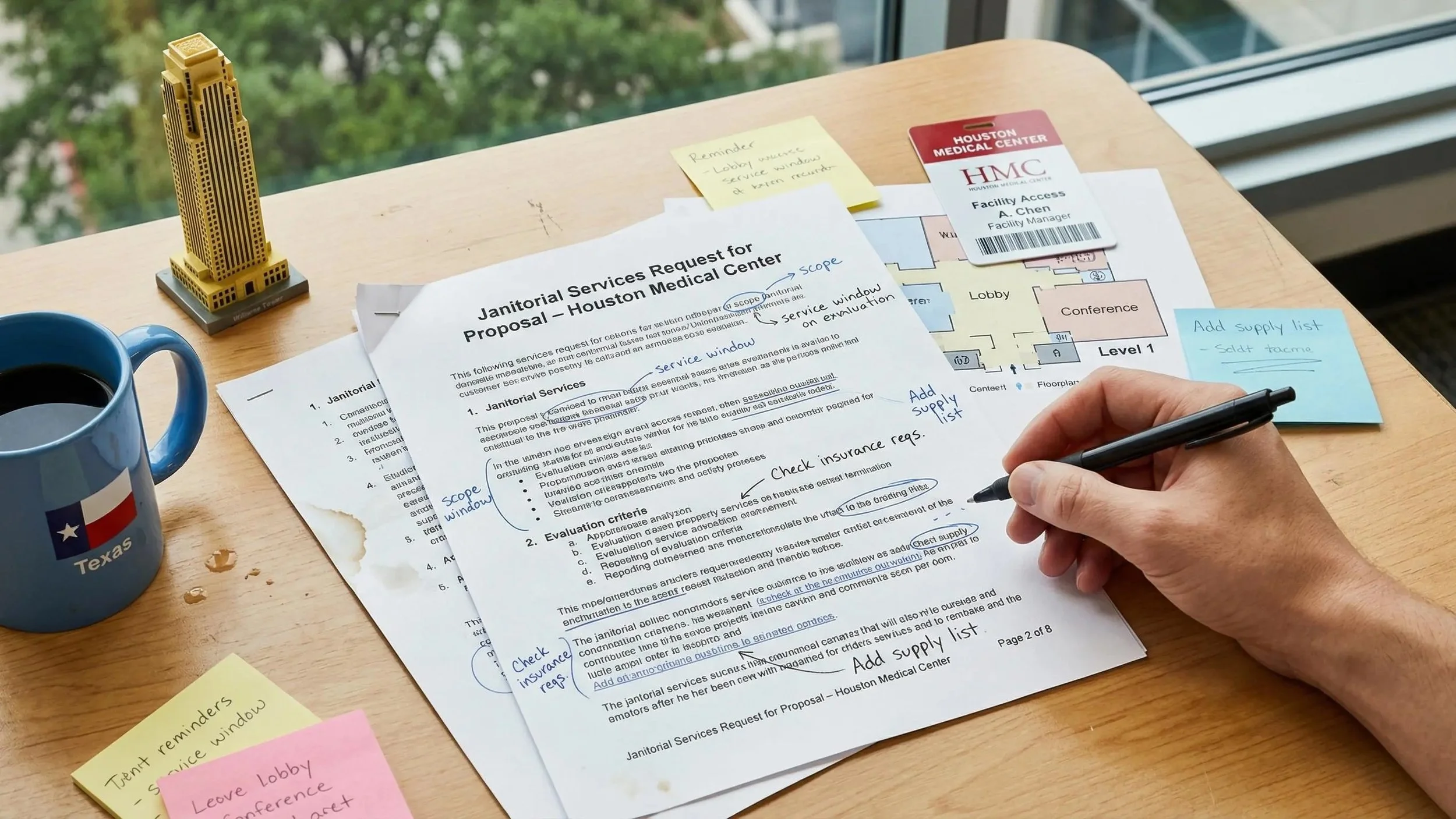
janitorial services RFP template Houston documents usually go sideways in the same places: vague scope, missing building details, and pricing sheets that let every bidder make different assumptions. If you're managing a school, office, medical building, or industrial site, that gets expensive fast (and messy).
What matters is simple: define the work, the frequencies, the access rules, and how service gets checked before pricing starts driving the conversation. That's where most teams get tripped up.
Restroom counts and floor types change labor more than people expect
"As needed" language usually turns into disputes
A clean pricing form makes bad comparisons easier to spot
Read this and your next RFP will be tighter.
What a Janitorial Services RFP Template Should Actually Do
A usable janitorial services rfp template houston teams rely on should do more than collect prices. It should shape the decision before vendors ever start filling in numbers.
A quote request asks, "What's your price?" A janitorial bid usually adds a scope and asks vendors to price it. A full RFP goes further. It defines expectations, qualifications, service standards, submission rules, and how you'll evaluate responses. That's a different level of control.
For a smaller, straightforward office with no special risk factors, a simple scope sheet may be enough. For larger facilities, multi-site portfolios, schools, airports, medical buildings, industrial sites, and institutional environments, it usually isn't. In those places, cleaning affects health outcomes, occupant confidence, security, and operations. If the request is vague, the problems show up after award.
A weak RFP doesn't save time. It just delays the mess.
This guide is built to help you use the RFP as a risk-control tool. Not paperwork. A working document.
Why Houston Facilities Need a More Specific Commercial Cleaning RFP
Houston operations have a way of exposing every vague sentence in a cleaning contract. High traffic, humid conditions, tight service windows, mixed-use spaces, and the need for quick response all put pressure on your scope.
When an RFP says things like "maintain cleanliness" or "service as needed," vendors fill in the blanks differently. One prices a lean nightly program. Another assumes day support. Another includes periodic floor work in the base price. Then procurement gets three numbers that look comparable but aren't tied to the same service model.
Facility teams here are usually balancing several things at once:
sanitation standards
occupant or tenant experience
limited disruption during operating hours
budget discipline
responsiveness when something goes sideways
A stronger commercial cleaning rfp texas document defines how work is measured, not just what gets cleaned. That means frequencies, inspection expectations, response times, and site conditions are all visible up front. Fewer disputes. Less backtracking. Better vendor fit.
RFP vs. Proposal vs. Bid: What Procurement Teams Need to Know
This part gets mixed up all the time. The RFP is your document. The proposal or bid is the vendor's response.
A proposal usually tries to sell the company. A bid is often narrower and more price-focused. Neither one fixes a poorly written request. If you're asking how to bid out janitorial services, start with the quality of the request itself. Vendors can only price clearly when you define the work clearly.
Here's the practical issue. Competitive pricing only means something when vendors are pricing the same scope, frequencies, standards, and constraints. If one company includes porter support, restroom touch-up, and quarterly carpet extraction while another doesn't, your review team is comparing formats, not value.
That is where apples-to-oranges review starts. Quietly, and early.
When to Use a Full Janitorial RFP Instead of a Basic Scope Sheet
Sometimes a one-page scope works. Often it doesn't. The more contract value, risk, and internal scrutiny involved, the more structure you need.
A full process makes sense when the service is:
high value or multi-year
spread across several buildings or locations
subject to formal procurement review
tied to controlled access or limited service windows
serving health-sensitive or safety-sensitive environments
It also matters when your janitorial contract requirements go beyond routine cleaning. Background checks, SDS management, OSHA awareness, infection control practices, security procedures, reporting expectations, and documentation standards should not be left to post-award interpretation.
If access is restricted, if cleaning has to happen without disrupting production or patient flow, or if your stakeholders expect formal accountability, use the full RFP. That's not overbuilding the process. That's matching the process to the risk.
The Core Sections Every Houston Janitorial RFP Template Should Include
A good template should move from context to scope to evaluation without making vendors guess what matters. Keep it clean and in order.
At minimum, include these sections:
Cover page with organization name, facility or portfolio, deadline, contract term, and point of contact
Organization overview with enough operating context to price correctly
RFP objective stating services requested and desired outcomes
Timeline with walkthrough, questions, due date, review window, interviews if needed, and target award
Locations of service with addresses and estimated square footage
General requirements covering service hours, invoicing, contract structure, and review meetings
Scope of work and specifications with frequencies and standards
Proposal submission requirements
Evaluation criteria
Contract and compliance requirements
Don't bury key rules in paragraph twelve on page seven. If you want comparable responses, make the path obvious.
How to Write the Facility Overview So Vendors Price the Right Work
This section does more work than most teams realize. Bad building data creates bad labor plans, and bad labor plans create service failure by the second week.
Be specific about the property type. Office, school, medical, industrial, airport support space, church, each one changes staffing logic. Include total square footage and, if useful, square footage by building or suite. Call out excluded areas so nobody prices space you don't expect them to clean.
It also helps to list the details vendors usually have to chase down later:
hours of operation
occupancy or traffic patterns
restroom and fixture counts
elevators, stairwells, and break areas
floor types
janitorial closets
waste and recycling requirements
sustainability goals or LEED-related expectations
If you have floor plans or stacking plans, attach them. Assumptions multiply when layouts are hidden. Better building data gives you more comparable bids and fewer scope disputes once the contract starts.
How to Define the Scope of Work Without Leaving Gaps
The cleanest way to write scope is by frequency and by area. Daily, weekly, monthly, quarterly, semiannual, annual. Then tie tasks to actual use.
Routine work should include items like trash removal, dusting, restroom sanitation, touchpoint cleaning, and floor care. Periodic work should be separate. Carpet extraction, VCT strip and wax, tile and grout restoration, high dusting. Don't bury those inside a monthly base number and hope everyone interprets it the same way.
For more complex facilities, break it down room by room or zone by zone. Especially for medical, school, and industrial settings.
A practical structure looks like this:
Required routine services
Nightly cleaning, restroom care, common area maintenance, trash and recycling
Required periodic services
Floor maintenance cycles, deep cleaning tasks, high dusting
Optional or as-needed services
Post-construction cleaning, power washing, emergency response, temporary labor
Daytime support if needed
Day porter services, event support, restroom touch-up, spill response
Copying a generic scope from another building is how you buy the wrong program for the right address.
The Health, Safety, and Sanitization Standards to Put in the RFP
If health matters in your facility, say what that means. "Keep the building clean" is not a sanitization standard.
Define expected outcomes. Include high-touch disinfection where appropriate. State whether EPA-approved or hospital-grade disinfectants are required in specific areas. Mention electrostatic spraying only if it actually fits your risk profile and operating goals. Not every building needs it, and not every vendor uses it well.
You should also spell out methods that protect indoor conditions, not just appearances:
HEPA vacuum use where dust control matters
color-coded tools to prevent cross-contamination
separation of tools by area
documented cleaning protocols
chemical handling expectations
PPE requirements
site hazard communication rules
For healthcare-related or privacy-sensitive spaces, infection control awareness and discreet work practices should be explicit. Cleaning for health is different from cleaning for looks. Good RFP language should reflect that.
The Security and Access Requirements Many RFPs Miss
A lot of RFPs are detailed about trash and vague about access. That's backwards.
In controlled environments, your janitorial services rfp template houston teams use should define lock-in and lock-out procedures, badge rules, restricted zones, alarm protocols, and expectations for preventing unauthorized entry. If a crew is working after hours, you need direct accountability for who is on site and when.
Ask vendors to explain:
background screening standards
site-specific security training
attendance tracking methods
work order documentation
how after-hours activity is recorded
Schools, medical facilities, airports, and office properties with controlled suites all need this language. If security isn't written into the request, it becomes a verbal expectation later. Verbal expectations don't hold up well at 10:30 p.m.
Why Staffing Model Belongs in Your Evaluation Criteria
This is not just an HR detail. It's an operating model issue.
Ask whether work is performed by direct W-2 employees or subcontracted labor. That choice affects supervision, training consistency, workers' compensation handling, insurance clarity, and site accountability. It also affects whether the same standards show up every night or drift over time.
Request details on onboarding, background checks, retention, and supervision. For larger sites, ask for team composition. Who supervises? Who handles utility work? Is there a defined team cleaning model for restrooms, vacuuming, light-duty tasks, and support?
Staffing model tells you how the service will behave when no one from your team is watching.
That's worth scoring.
Green Cleaning and Sustainability Requirements to Include
If sustainability matters to your organization, build it into the request instead of treating it like a side note. A commercial cleaning rfp texas process can include green cleaning standards without weakening performance expectations.
Ask vendors how they handle:
chemical selection and dilution control
microfiber systems
HEPA filtration
energy-efficient equipment
crew training on green protocols
If you're working toward LEED or broader wellness goals, say so. But keep the language practical. Sustainable cleaning still has to meet sanitation and appearance standards. Done right, it supports occupant health, reduces unnecessary chemical exposure, and aligns with environmental commitments without turning into a marketing label.
Quality Control, Reporting, and Accountability Standards
A promise to inspect the site is not a quality control system. Ask for the actual process.
Require vendors to describe inspection frequency, who performs audits, what checklists are used, how issues are escalated, and how corrective action is tracked. Job cards, cleaning logs, response-time standards, and sample reports help you see whether transparency is real or just promised.
In multi-building environments, standardized QC matters even more. It gives your team a way to verify completion, spot trends, and catch drift before complaints pile up.
One missed trash pull is an annoyance. Repeated undocumented misses are a system problem.
How to Structure Proposal Submission Requirements for Easier Comparison
If you want cleaner evaluation, require cleaner submissions. Tell vendors to answer in the same order as the RFP.
Request a company overview, relevant facility-type experience, staffing plan, transition plan, safety program, QC plan, and pricing in a consistent worksheet. Require assumptions, exclusions, and optional services to be listed clearly. Hidden gaps should surface before award, not after mobilization.
Also include the basics: question process, due dates, file format, contact method, proof of insurance, compliance documents, and relevant references. If interviews or presentations are part of the process, say it up front.
Structure reduces subjectivity in cleaning services procurement. It also saves your review team from rebuilding every response into a common format by hand.
What to Ask Vendors About Safety and Compliance
Safety language should match the environment. General office standards aren't enough for industrial sites, medical buildings, or airport-related spaces.
Ask for details on training, site inspections, PPE practices, chemical safety, SDS access, hazard communication, field supervision, and incident response. Then push one step further. How are protocols adapted for machinery areas, secure zones, patient-facing spaces, or production environments?
That is where weak answers show up.
These are core janitorial contract requirements, not administrative extras. They protect your people, the vendor's workforce, and the continuity of operations.
A Practical Scoring Framework for Evaluating Janitorial RFP Responses
Score beyond price. If you don't, the process will drift there anyway.
A practical scoring model might include scope completeness, relevant experience, staffing model, safety program, security readiness, QC systems, sustainability alignment, transition plan, references, and price. Weight the categories based on risk. Sensitive environments should put more weight on quality controls and operational discipline than a straightforward low-complexity site.
Lowest bid does not always mean lowest cost over the contract term. Rework, complaints, turnover, missed security steps, and poor transition planning are all expensive. They just hit different budget lines.
How to Bid Out Janitorial Services Step by Step
If you're working through how to bid out janitorial services, keep the sequence disciplined:
Gather facility data, pain points, and stakeholder requirements
Decide whether you need a quote request, bid, or full RFP
Build the scope with frequencies, exclusions, and site conditions
Document access, compliance, safety, and reporting expectations
Hold a walkthrough so vendors can inspect conditions
Issue the RFP with firm deadlines and instructions
Answer questions consistently for all participants
Review with a scoring framework
Interview finalists and test assumptions, staffing, and transition plans
Award based on operational fit and long-term value
The walkthrough matters more than people think. You can learn a lot from the questions vendors ask in the building.
Common Mistakes That Weaken a Commercial Cleaning Tender in Houston
Most weak documents fail in predictable ways. Not dramatic. Just costly.
Common problems include vague scope language, missing building details, no security notes, lump-sum pricing requests, mixed routine and emergency work, undefined QC expectations, and too much weight on price. Another one we see often is treating every facility type the same. A medical building, school, industrial site, and office tower should not be procured with interchangeable language.
A weak commercial cleaning tender houston teams issue usually creates confusion long before award. You can feel it in the vendor questions.
Sample Janitorial Services RFP Template Structure You Can Adapt
Use this as a starting framework:
RFP summary and organization overview
Timeline and procurement process
Facility locations and square footage
Building details and operating conditions
Scope of work by area and frequency
Special services and optional pricing lines
Health, safety, and disinfecting standards
Security, access, and personnel requirements
Sustainability and green cleaning expectations
Quality control, inspections, and reporting
Proposal format and required attachments
Pricing worksheet structure
Evaluation criteria and award process
Contract requirements and onboarding expectations
If your service mix includes routine janitorial services, deep cleaning and floor maintenance, and day porter services, keep those distinct. Vendors price more accurately when recurring work and asset-protection work aren't blended together.
What a Strong Vendor Response Looks Like
The best responses are rarely the flashiest. They are the clearest.
Look for a response that understands the scope with minimal assumptions, matches the pricing structure you requested, separates routine and optional work, explains staffing and supervision plainly, and shows documented safety, security, and QC systems. Relevant facility experience should be specific to your environment, not generic corporate language.
A strong response also includes a realistic transition plan. Not "we ensure a seamless startup." Actual steps. Actual accountability.
How PJS of Houston’s Perspective Can Help You Build a Better RFP
From our side of the table, facility managers usually get better results when the RFP is built around health-focused cleaning, documented accountability, and site-specific protocols. Those three things tend to expose whether a vendor has an operating system or just a sales process.
We'd also encourage you to evaluate the staffing model carefully. In-house, trained W-2 teams generally provide stronger consistency and security than loosely managed subcontracted crews. Standardized checklists, audits, and tailored cleaning plans make service measurable. That's true whether you're procuring routine janitorial services, periodic floor maintenance, or day porter support.
Use those criteria no matter who you invite to bid. Good procurement should raise the standard for everyone.
Conclusion
A strong janitorial RFP is not just a purchasing document. It's a framework for protecting health, safety, security, and service consistency before the contract starts.
The best templates define scope clearly, require meaningful vendor disclosures, and make evaluation more objective. Before you issue your next commercial cleaning tender houston opportunity, review your current document against the sections above. Tighten the places where assumptions are doing too much work. Then adapt the template to your facility type, risk level, and operating reality so the responses you get reflect the job you actually need done.